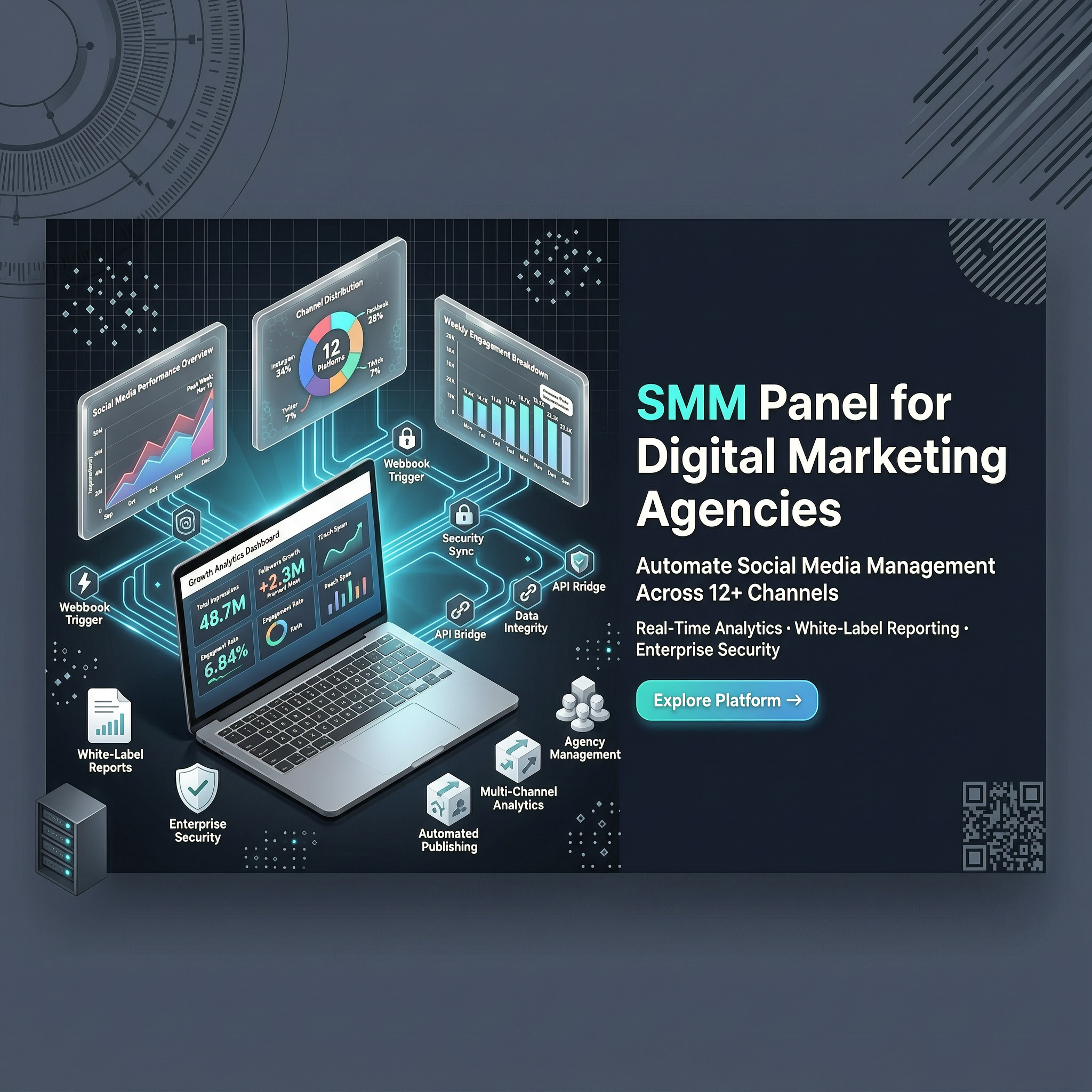
SMM Panel for Digital Marketing Agencies: How Agencies Scale Client Social Proof & Reporting (2026 Guide)
For modern digital marketing agencies, managing client expectations during the first 90 days of an engagement is one of the most significant operational challenges. When an agency onboards a new client—whether an emerging direct-to-consumer (DTC) e-commerce brand, a B2B enterprise software provider, a medical practice, or a local service franchise—the client expects immediate authority, visible engagement, and undeniable market credibility across their digital touchpoints.
However, purely organic inbound marketing strategies (such as content production, technical SEO, and community management) often require three to six months to generate visible social momentum. During this initial lag phase, brand profiles with low follower counts, zero comments, and minimal video views suffer from the "Cold Start Problem": paid advertising traffic converts at lower rates because prospective customers perceive the brand as unvetted or inactive.
To bridge this credibility gap, forward-thinking digital marketing agencies incorporate enterprise-grade SMM panel infrastructure into their fulfillment stacks. By utilizing automated wholesale panels as backend fulfillment engines, agencies programmatically deliver baseline social proof, establish immediate profile authority, improve paid ad conversion efficiency, and package these enhancements into high-margin, recurring retainer contracts.
This comprehensive 2026 agency guide outlines the operational blueprint for integrating an SMM panel into your agency workflow. We cover white-label client packaging, automated REST API fulfillment, quality control and retention guarantees, drip-feed delivery velocity modeling, executive client reporting frameworks, and risk mitigation protocols.
To explore live wholesale service tiers, execution velocities, and agency pricing, browse the SafeSMM Services Directory. Agencies automating high-volume fulfillment can review developer endpoints via the SafeSMM API Documentation, and establish an enterprise agency workspace on the SafeSMM Registration Portal.
1. The Agency Dilemma: Overcoming the Cold Start Problem in Client Growth
Every digital agency faces the same fundamental onboarding challenge: when driving paid media (Google Ads, Meta Ads, programmatic display) to a client’s landing page or social profile, prospective buyers perform immediate background due diligence.
If a consumer sees an innovative product advertised on Instagram, clicks through to the brand profile, and finds 42 followers and zero comments, psychological friction immediately increases. Despite the quality of the product or service, the conversion rate plummets because human psychology relies heavily on social proof heuristics—the subconscious assumption that if others are not engaging with a brand, the brand is unproven, risky, or illegitimate.
The "Cold Start" Impact on Agency Performance:
- Higher Customer Acquisition Costs (CAC): Paid ads converting on low-authority profiles experience up to a 40% to 60% penalty in cost-per-acquisition.
- Client Churn in Month 1–3: Clients who do not see visible social validation within their first 60 days frequently cancel retainers before organic SEO or long-term content strategies mature.
- Wasted Creative Production: High-budget video production assets underperform when published to barren channels with zero initial algorithmic reach.
Enterprise-tier SMM panels solve this dilemma by providing agencies with an on-demand, programmatic infrastructure to seed baseline social proof instantly, dramatically lowering paid ad CAC and stabilizing client retention during the critical early onboarding window.
To learn how small businesses and agencies approach early social proof strategies, explore our comprehensive guide on Social Media Marketing for Small Business: Growth & Scaling Strategies.
2. What Distinguishes an Agency-Grade SMM Panel from Retail Panels?
Not all SMM panels are built for agency deployment. While low-end "retail" panels cater to casual users seeking one-off vanity spikes at rock-bottom prices, marketing agencies require enterprise-grade stability, dedicated account managers, predictable delivery schedules, and programmatic reporting capabilities.
| Operational Feature | Retail / Budget SMM Panels | Agency-Grade Master Panels (SafeSMM) |
|---|---|---|
| Infrastructure Sourcing | Unstable scraped nodes; high volatility | Direct residential proxies & aged delivery clusters |
| Retention & Guarantees | No-refill; 40%–80% drops within days | Verified 30 to 60-day auto-refill warranties |
| API Architecture | Unstable endpoints; frequent timeouts | High-throughput REST API with 99.9% uptime |
| Delivery Velocity Controls | Instant aggressive bursts only | Configurable drip-feed & scheduled intervals |
| Customer Support SLA | Unresponsive or delayed ticket desks | Dedicated agency account management & 24/7 technical desk |
| Data Privacy Standards | Ambiguous data logging policies | Strict link-only public processing; zero credential capture |
For an in-depth breakdown of how upstream aggregator backends communicate with source server networks, read our architectural overview on How SMM Panels Actually Work Behind the Scenes.
3. Multi-Channel Agency Use Cases (Instagram, YouTube, Facebook, LinkedIn, X)
Full-service digital agencies manage diversified client portfolios spanning multiple social networks. An agency-grade panel provides standardized execution across all major public platforms:
1. Instagram Brand Authority & Reel Distribution
For consumer brands, influencer clients, and e-commerce stores, agencies utilize SMM panel infrastructure to:
- Seed initial high-retention followers on newly registered brand accounts (establishing a baseline of 5k–10k followers).
- Deliver initial Reel views and saves within the first 60 minutes of publication, signaling early content velocity to organic recommendation engines.
- Maintain balanced engagement ratios (post likes, custom niche comments, profile shares) to ensure aesthetic credibility.
2. YouTube Video Authority & Watch Time Acceleration
For corporate podcast channels, software product demos, and brand channels:
- High-retention video views (with guaranteed average view durations of 3–5+ minutes) to build authority on pillar long-form content.
- Targeted subscriber acquisition to achieve baseline channel credibility.
- Comment seeding to stimulate organic viewer discussions and debate.
3. LinkedIn Corporate & Executive Presence
For B2B agency clients, executive personal brands, and enterprise software startups:
- Company page follower expansion to match enterprise corporate scale.
- Executive post reactions and professional shares to amplify thought-leadership content before prospecting campaigns begin.
4. Facebook & X (Twitter) PR Campaign Amplification
For event marketing, public relations announcements, and national brand pages:
- Facebook Page likes and review engagement to optimize local SEO map pack signals and ad trust scores.
- X (Twitter) retweets and quote posts during major product announcements, press releases, or fundraising launches.
To understand how agencies compare service specifications and delivery speeds, explore our guide on Cheap SMM Panels With Fast Delivery: Quality Verification Checklist.
4. Packaging & Pricing: Integrating Social Proof into Recurring Agency Retainers
Top-performing digital marketing agencies never bill clients for raw metrics (e.g., billing a client "$15 for 1,000 followers"). Selling commodity metrics devalues agency positioning, encourages micromanagement, and invites pricing resistance.
The Productized Agency Retainer Model:
Instead, agencies integrate social proof delivery into comprehensive, high-value Growth Packages and Monthly Retainers where backend fulfillment costs represent a small fraction of the overall contract value.
| Agency Retainer Tier | What the Client Receives (Public Facing) | Backend Fulfillment Stack | Wholesale Cost | Client Retainer Price |
|---|---|---|---|---|
| The Brand Launchpad (Onboarding Month 1) |
Complete profile setup, 12 custom creatives, profile authority seeding, ad pixel integration. | 5,000 High-Retention Followers + 500 Likes/Post across first 12 posts. | ~$25.00 | $1,500 – $2,500 / month |
| The Content Accelerator (Ongoing Retainer) |
Weekly content creation (4 Reels/week), community management, continuous engagement amplification. | Drip-feed: 2,500 views + 200 likes + 15 custom comments per Reel. | ~$35.00 / mo | $2,500 – $4,500 / month |
| The Executive Authority Stack (B2B & Corporate) |
Ghostwriting for CEO, 8 LinkedIn articles, corporate channel management, PR distribution. | LinkedIn post amplification + YouTube video authority views. | ~$50.00 / mo | $5,000 – $8,500 / month |
By wrapping raw wholesale delivery inside creative production, copywriting, and strategic consulting, your agency maintains 85% to 95%+ gross profit margins while delivering visible, immediate value that keeps clients retained for 12+ months.
For complete blueprints on structuring client acquisition funnels and productized packages, consult our guide on the SMM Reseller Business Guide: Pricing, Profit & Client Acquisition.
5. White-Label Delivery Workflows: Manual vs. Fully Automated REST API Ingestion
As an agency scales from 5 to 50+ active client accounts, executing orders manually through a web dashboard creates operational bottlenecks. Modern agencies automate order fulfillment by connecting their internal project management software, customer onboarding forms, or custom dashboards directly to the provider API.
1. Webhook-Driven Client Onboarding Pipeline:
- Client Submits Onboarding Form: The client signs their contract and submits their public profile handles and target URLs via an onboarding intake form (Typeform, ClickUp, HubSpot).
- Zapier / Make / Webhook Trigger: The form submission triggers an automated webhook that parses the target URLs and sends an authenticated HTTP POST payload to the SafeSMM REST API.
- Automated Order Dispatch: The API executes the requested service package (e.g., initiating a 30-day drip-feed follower schedule).
- Database Logging: The upstream
order_idis automatically logged into the client’s record inside your agency CRM (Monday.com, Airtable, Notion) for real-time tracking.
6. Quality Control & Retention Management: Safeguarding Client Reputation
For marketing agencies, client trust is paramount. If a client observes a sudden 40% drop in followers or views two weeks after delivery, they will question the integrity of the agency’s entire marketing strategy.
The 4-Pillar Agency Quality Assurance Protocol:
- Whitelist Tier 2 and Tier 3 Services Only: Never purchase raw, unvetted budget services for agency clients. Curate an approved internal catalog containing only high-retention services delivered via residential routing networks and aged profile clusters.
- Always Select 30 to 60-Day Refill Guarantees: Ensure every follower or subscriber service ordered includes an active refill warranty. If natural platform maintenance sweeps cause minor attrition, automated refill daemons replace unfulfilled units instantly.
- Apply a 5%–10% Over-Delivery Buffer: Configure internal order batches to deliver slightly above client thresholds (e.g., ordering 5,500 units when promising the client 5,000). This buffer absorbs natural baseline audience decay without dropping below the client’s paid benchmark.
- Track Order States Programmatically: Utilize automated cron status polling to catch stalled or partial orders before the client notices.
To understand the technical mechanics of social media drops and refill algorithms, read our comprehensive guide on How to Reduce Drops in Social Media Services: Complete Retention Guide.
7. Drip-Feed & Velocity Scheduling: Engineering Natural Growth Curves
One of the most critical responsibilities of an agency media buyer is managing delivery velocity. Delivering 20,000 followers in a single 15-minute burst to a brand-new Instagram account with 3 posts is an obvious algorithmic anomaly that can trigger platform security flags.
Calculating the Natural Growth Velocity Curve:
Safe Daily Delivery Velocity = Base Profile Count * (0.05 to 0.15) + Organic Baseline
Practical Agency Drip-Feed Setup (Example: 10,000 Followers Package):
- Total Campaign Goal: 10,000 Followers
- Drip-Feed Configuration:
Quantity = 500,Runs = 20,Interval = 720 minutes (every 12 hours). - Execution Timeline: Smooth delivery over 10 consecutive days.
- Complementary Signal: Concurrently dispatch 50–100 likes across all published posts during the 10-day window to maintain natural engagement-to-follower ratios.
By utilizing drip-feed scheduling, agencies create realistic growth trajectories that mimic organic viral discovery, ensuring total safety and compliance for high-value client assets.
8. Client Reporting Frameworks: Translating Social Proof into Executive ROI
Corporate clients and marketing directors do not want to see raw SMM order logs. High-performing agencies synthesize social growth into polished, executive-ready monthly reports using enterprise BI dashboards (such as Looker Studio, AgencyAnalytics, or DashThis).
The 3-Tier Executive Reporting Structure:
- Top-Line Authority Growth (Macro Metrics):
- Total Audience Reach & Aggregate Follower Growth (+X% Month-over-Month).
- Channel Impression Volume & Video Consumption Minutes.
- Brand Search Volume & Profile Visit Velocity.
- Engagement Depth & Community Response (Micro Metrics):
- Average Engagement Rate per Post (Likes, Comments, Saves, Shares).
- Video Completion Rate & Retention Curves on Pillar Assets.
- Commercial Conversion Impact (Bottom-Line ROI):
- Paid Ad Click-Through Rate (CTR) improvements resulting from enhanced social proof.
- Landing page conversion rate increases (+Y% post-authority seeding).
- Inbound lead inquiries, direct messages, or direct e-commerce sales.
9. Account Security & Risk Mitigation: Protecting High-Value Client Assets
Digital agencies hold a fiduciary responsibility to safeguard client digital properties. Under no circumstances should an agency jeopardize client account security through high-risk growth practices.
The Agency Zero-Trust Security Protocol:
- 100% Public-Link Execution: Never utilize services requiring account passwords, session cookies, browser extensions, or administrative API access tokens. Reputable SMM panels operate purely on public URL routing.
- Never Change Usernames Mid-Delivery: Instruct clients and account managers that social handles (e.g.,
@clientbrand) must remain fixed during active campaigns. Changing a handle breaks database tracking and voids refill warranties. - Maintain Continuous Public Visibility: Ensure client accounts remain set to Public. If a client accidentally switches a profile to Private, delivery nodes encounter access blocks, triggering automated cancellations.
To understand how order states transition and how automated refunds operate when link errors occur, review our technical guide on SMM Panel Order Status Meanings & Balance Workflows.
10. Financial Architecture: Multi-Currency Billing, Cash Flow & Margin Optimization
Managing a scalable agency requires disciplined financial engineering. Because upstream SMM fulfillment operates on a pre-funded wallet balance, agencies must structure client billing to maintain positive operational cash flow.
Best-Practice Financial Workflow:
- Upfront Client Billing (Retainer Invoicing): Always collect client retainer payments upfront (via Stripe, Credit Card, or Automated ACH) on the 1st of each month before dispatching backend fulfillment orders.
- Maintain Master Wallet Reserves: Maintain a funded reserve buffer (e.g., $250 to $1,000) inside your master provider account to ensure automated API orders execute without pending delays.
- Global Payment Gateways: When working with international clients, offer frictionless payment rails including credit cards, PayPal, and cryptocurrency.
For detailed insights into payment processor compliance, fee management, and PayPal verification, read our guide on SMM Panels With PayPal: Safe Provider Verification.
11. Standard Operating Procedures (SOPs) for Account Managers & Media Buyers
To scale past 20+ clients without operational chaos, your agency must document repeatable Standard Operating Procedures (SOPs) for internal team members:
Internal Agency SOP: Monthly Client Social Proof Execution
- Day 1 (Content Audit): Account Manager reviews the client’s monthly publishing calendar and extracts target URLs for scheduled video releases, Reels, and PR announcements.
- Day 2 (Package Mapping): Media Buyer assigns approved Service IDs from the internal whitelist, sets drip-feed intervals, and schedules outbound API dispatches to align with content publish dates.
- Day 15 (Mid-Month Retention Audit): Media Buyer checks client profile metrics against baseline Start Counts. If any metric dropped below target, trigger an automated 1-click refill via the SafeSMM dashboard.
- Day 28 (Executive Report Generation): Account Manager exports consolidated analytics into Looker Studio, reviews conversion metrics, and schedules the client monthly review presentation.
12. Scaling Agency Operations: Infrastructure Redundancy & Team Delegation
As your agency scales toward seven-figure annual revenues, operational resilience becomes vital. Enterprise agencies protect their operations through structured team delegation and infrastructure redundancy:
1. Role Specialization within the Agency Stack:
- Creative Strategists: Focus entirely on high-converting content production, video editing, and copywriting.
- Technical Media Buyers: Manage API dispatch pipelines, webhook integrations, and catalog whitelisting.
- Account Executives: Interface directly with corporate clients, presenting reports and upselling specialized service tiers.
2. Building Independent Agency Portals:
Advanced marketing agencies often deploy dedicated white-label client portals where clients can log in, view live campaign progress, and request additional service packages directly under the agency’s proprietary branding.
To learn how to structure white-label agency platforms, explore our complete technical guide on White Label SMM Panels Explained: How Agencies Scale in 2026.
13. Growth Blueprint: How Agencies Scale from $5k to $50k/Month Retainers
Consider the operational trajectory of a boutique digital growth agency specializing in e-commerce brand scaling:
The Initial Bottleneck ($5k/mo):
The agency managed 3 clients, executing all organic posting manually. Clients complained about slow follower growth, and paid ads on newly launched Instagram stores converted poorly (CAC > $65.00). Client churn averaged 60 days.
The Strategic Shift ($25k/mo):
The agency integrated SafeSMM’s wholesale API infrastructure into their onboarding stack. Every new client received the "Brand Authority Onboarding Package" (5,000 high-retention followers, 500 likes per post, drip-fed over 14 days). Paid ad CAC dropped immediately by 34% because landing page visitors perceived the brand as established. Client churn fell to under 5%.
The Enterprise Scaling Phase ($50k+/mo):
The agency productized their offerings into three recurring monthly tiers ($2,500, $4,500, and $7,500/mo), managing 15+ enterprise clients with automated webhook-driven API fulfillment. Backend fulfillment costs remained under 3% of gross revenues, leaving over $45,000/month in net agency profit to reinvest in talent, creative production, and outbound client acquisition.
14. Frequently Asked Questions (FAQs)
1. Is it safe for digital marketing agencies to use an SMM panel for client accounts?
Yes, provided the agency uses enterprise-grade, link-only services that operate strictly via public URLs. Reputable providers never request account passwords or access tokens. When paired with realistic drip-feed velocity controls and balanced engagement ratios, SMM fulfillment is completely safe.
2. How should an agency explain SMM metrics in client reporting?
Position social proof as a foundational Conversion Rate Optimization (CRO) and Authority Catalyst. Explain that building baseline visibility elevates brand perception, reinforces consumer trust, and significantly lowers customer acquisition costs across paid media channels.
3. Can an agency automate order fulfillment directly from their CRM?
Yes. By connecting your agency intake forms (Typeform, HubSpot, ClickUp) to the SafeSMM REST API via webhooks or custom PHP scripts, order packages can be dispatched to upstream fulfillment nodes automatically upon contract signing.
4. What happens if a client’s follower or view count experiences a drop?
When ordering high-retention agency services with 30 or 60-day refill guarantees, any natural platform attrition is automatically restored by triggering a 1-click refill (or automated API refill request) at zero extra cost.
5. How much profit margin can an agency expect on SMM fulfillment?
Because agencies package wholesale metrics inside comprehensive creative, strategic, and reporting retainers, gross profit margins routinely exceed 80% to 95%.
6. Where can agencies review live wholesale rates and API documentation?
Agencies can review live service catalogs, real-time start speeds, and API endpoint documentation directly on the SafeSMM Services Catalog and the SafeSMM API v2 Portal.
15. Conclusion & Actionable Agency Implementation Plan
Incorporating an enterprise SMM panel into your digital marketing agency is not about chasing vanity metrics—it is a strategic growth accelerator designed to eliminate the Cold Start Problem, optimize paid media conversion rates, protect client retention, and maximize agency profitability.
By selecting verified Tier 2 and Tier 3 high-retention services, configuring automated drip-feed delivery schedules, adhering to strict zero-trust account security, and presenting polished executive reports, your agency can deliver unmatched commercial value to clients worldwide while scaling operations seamlessly.
Scale Your Agency Fulfillment with Enterprise Infrastructure
Access raw wholesale pricing, 99.9% API uptime, 30-day refill guarantees, and 24/7 dedicated agency developer support.
Explore Wholesale Services Create Agency Workspace