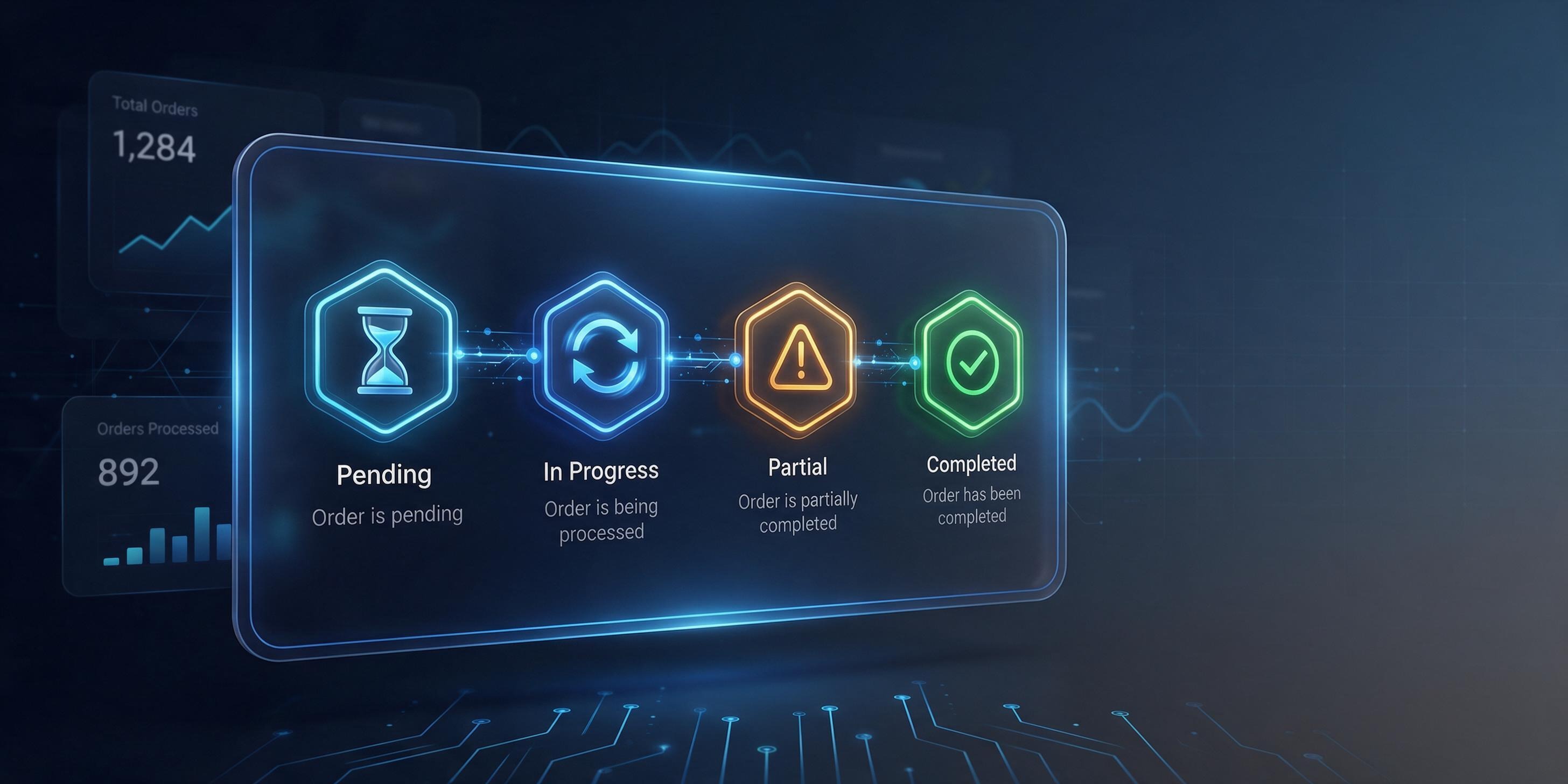
SMM Panel Order Status Meanings: Pending, In Progress, Partial, Canceled & Refunded Explained (2026 Guide)
If you purchase or resell digital marketing services through an SMM platform, understanding SMM panel order statuses is essential for smooth operations. Whether you are an individual creator checking delivery progress, an agency managing marketing campaigns for multiple brands, or a platform reseller automating thousands of client requests daily, order statuses represent the real-time communication link between your dashboard, backend database engines, and upstream server providers.
When an order does not transition immediately from submission to completion, questions arise: Why is my order still pending? What does a partial delivery actually mean? Did I lose my funds on a canceled request? How are remaining units calculated?
This comprehensive guide explains every standard SMM panel order status in detail. We cover the technical lifecycle of an order, the mathematical logic behind partial deliveries and balance adjustments, common delivery blockers, API polling mechanisms, and standard operating procedures (SOPs) for resellers handling client support tickets.
To review live service specifications, delivery windows, and execution rules, browse the SafeSMM Services Catalog. New agencies and resellers can establish a secure workspace via the SafeSMM Registration Portal, and developers can review automated status endpoints in the SafeSMM API Documentation.
1. Quick Reference Matrix: SMM Order Statuses at a Glance
Every order processed through an automated SMM architecture transitions through distinct programmatic states. The table below outlines these universal statuses, their technical meaning, the financial impact on your account balance, and the appropriate user action.
| Order Status | Technical Definition | Balance Status | Standard User Action |
|---|---|---|---|
| Pending | Order registered in local database; awaiting dispatch or acceptance by the provider server queue. | Funds Deducted / Held | Allow standard start window (typically 5–60 mins). Do not resubmit. |
| Processing | Order received by dispatch server; link formatting and initial metrics verified. | Funds Deducted | System is actively assigning delivery nodes. Maintain public link access. |
| In Progress | Delivery engine actively streaming metric signals to the designated public target URL. | Funds Deducted | Monitor counter progression. Do not edit username, URL, or privacy settings. |
| Completed | Target metric confirmed delivered based on recorded start count and ordered quantity. | Fully Charged | Verify count on public link. Monitor retention if a refill window applies. |
| Partial | Delivery concluded prematurely due to platform limits, link issues, or queue saturation. | Pro-rated Refund | Check remaining balance credit. Review link stability before reordering remainder. |
| Canceled | Order rejected by system before delivery initiated (invalid URL, server overload, etc.). | 100% Refunded | Review link structure, confirm public visibility, and select an alternative service ID. |
| Refunded | Administrative or automated reversal applied post-submission due to systemic interruption. | 100% Refunded | Funds returned to platform balance. Reorder using updated target parameters. |
For advanced breakdowns on how backend aggregators communicate with primary provider infrastructures, explore our educational analysis on How SMM Panels Actually Work Behind the Scenes.
2. The Technical Lifecycle: What Happens Behind the Dashboard
When an end-user or API client interacts with an SMM platform, the system does not execute a manual action. Instead, it initiates a Finite State Machine (FSM) workflow governed by server-side validation, relational database state changes, and RESTful API network payloads.
The 6-Stage Programmatic Order Flow:
- Payload Ingestion & Ledger Validation: The user submits parameters (Service ID, Target URL, Quantity). The billing engine performs an atomic transaction, validating that available funds match or exceed
(Quantity / 1000) * Rate. Account balance is debited, and an internal order record is created inPendingstatus. - Sanitization & Pre-Flight Validation: Automated regex engines check link syntax (e.g., verifying that an Instagram link conforms to standard post/profile URI patterns). Minimum and maximum thresholds are strictly enforced against the catalog database.
- Upstream API Dispatch: A background daemon worker fetches pending records, compiles an encrypted JSON/cURL request containing provider authentication credentials, and sends an
action=addpayload to the upstream server. - Upstream Ingestion & Provider ID Mapping: The upstream provider validates the request, logs the initial metric on the target URL (the Start Count), assigns an upstream Provider Order ID, and returns an acknowledgment payload. The local database updates status to
ProcessingorIn Progress. - Cron Status Polling & Webhook Ingestion: Automated scheduled tasks (typically running every 60–300 seconds) query the provider’s
action=statusendpoint. Metrics such as dynamic delivery counters, remaining quantity (remains), and state changes are synced to the local customer dashboard. - State Resolution & Financial Reconciliation: Upon reaching terminal states (
Completed,Partial, orCanceled), the system closes the order loop. In partial or canceled events, the billing engine calculates exact unfulfilled units and executes an automated ledger credit back to the user’s platform balance.
3. Understanding "Pending" Status: Triggers, Queues & Normal Windows
The Pending state is the initial holding phase for every order entering an SMM system. When an order displays Pending, it indicates that the platform has recorded your request, debited the ledger, and placed the task into the server’s asynchronous dispatch queue.
Why Do Orders Remain in Pending?
- Dispatch Queue Congestion: High-volume provider hubs process tens of thousands of API calls per minute. If hundreds of orders enter the system simultaneously, requests are processed sequentially to avoid upstream API rate-limiting.
- Start Count Scraping Latency: Before delivery begins, provider nodes must scrape and record the public starting counter of your target link. If social network caching layers delay public metric visibility, the order remains pending until a verifiable start count is established.
- Upstream Server Handshakes: Reseller platforms route requests to upstream aggregators. If an upstream provider is undergoing routine database optimization or server synchronization, orders hold safely in a pending queue until the connection handshake confirms.
- Drip-Feed Scheduling Constraints: If an order utilizes drip-feed intervals, subsequent runs remain in pending or scheduled states until the designated time trigger elapses.
Acceptable Timeframes for Pending Status
Under standard operating conditions, the pending phase lasts between 0 and 30 minutes. Certain specialized services—such as high-retention video campaigns, staggered social growth, or targeted subscriber packages—may feature intentional startup delays ranging from 1 to 3 hours to mimic natural velocity patterns.
4. "Processing" vs. "In Progress": Operational Differences
While users and resellers often use the terms interchangeably, Processing and In Progress signify distinct stages within the order execution pipeline.
Processing: The Preparation Stage
When status reads Processing, the upstream delivery engine has accepted the API payload, parsed the destination URL, and verified that the target endpoint is reachable and public. At this stage:
- The system is allocating delivery worker nodes or engagement network slots.
- Initial metric counters (Start Counts) have been officially locked in the provider’s database.
- Physical delivery of metrics has not necessarily appeared on your public profile yet, but execution is fully queued.
In Progress: Active Delivery Execution
The transition to In Progress indicates that delivery algorithms are actively streaming interactions to the public target. During this phase:
- Engagement counters (views, likes, followers, impressions) begin incrementally populating on the target link.
- Platform status polling daemons actively monitor the remaining quantity (
remains) parameter. - Delivery speed adheres to the specific service parameters (e.g., instant burst versus gradual rate-controlled delivery).
If your agency manages high-tier reseller workflows, you can review our strategic guide on the Best Reseller SMM Panel Strategies to learn how leading platforms manage status communication to maintain high client retention rates.
5. "Completed" Status: Start Counts, Delivery Verification & Latency
An order achieves Completed status when the backend delivery engine determines that the full requested volume has been dispatched and verified against the initial starting baseline.
The Mathematical Logic of Completion:
Target Completion Metric = Start Count + Ordered Quantity
For instance, if your video possesses a verified Start Count of 1,500 views and you place an order for 5,000 views, the system flags the order as Completed when external network polling registers a total count of 6,500 views on that public URL.
Understanding Social Network Caching Latency
Occasionally, an SMM dashboard displays an order as Completed, yet your local mobile app still displays the older counter. This discrepancy is almost always caused by Content Delivery Network (CDN) edge caching implemented by major social platforms (Instagram, YouTube, Facebook, X).
Social networks distribute public metric data across thousands of global proxy servers. While backend delivery has concluded and central database records reflect the full count, local mobile applications often display cached data for 10 to 60 minutes. To confirm accurate completion:
- Open the target URL via a desktop browser in an incognito/private browsing window.
- Clear your mobile application cache or inspect the link via direct browser endpoints.
- Allow sufficient CDN propagation time before assuming a delivery shortfall has occurred.
6. Deep Dive: "Partial" Status Mechanics & Balance Calculations
The Partial status is one of the most critical mechanisms within modern SMM engineering. It occurs when a service successfully initiates delivery, fulfills a fraction of the requested quantity, but cannot safely complete the entire batch due to environmental or systemic constraints.
Why Do Orders Become Partial?
- Server Capacity & Node Thresholds: Every independent delivery server maintains finite daily inventory limits per target link. If a server reaches maximum throughput while fulfilling an order of 10,000 units after delivering 6,000 units, the system safely stops execution and marks the order as Partial.
- Platform Algorithmic Updates: Social networks frequently roll out security updates and metric validation filters. When a provider detects an update mid-delivery, the system pauses pending actions to protect the destination profile from unnatural delivery patterns.
- Target URL Adjustments: If a user changes their profile privacy to private, alters their public username, or deletes a target post while an order is actively delivering, provider scraper nodes can no longer access the link, triggering an immediate Partial status.
- Counter Overlap: If a customer places multiple concurrent orders for the same URL across different services or panels, provider counters collide, making further delivery tracking impossible and forcing a safe partial termination.
The Mathematical Partial Refund Formula
When an order goes Partial, users do not lose their funds. Modern panel billing engines automatically calculate the exact unfulfilled units and execute a pro-rated refund to your account balance.
Example Financial Calculation:
- Service Rate: $2.00 per 1,000 units
- Ordered Quantity: 5,000 units (Total Initial Charge: $10.00)
- Delivered Quantity: 3,500 units
- Remains (Unfulfilled): 1,500 units
Pro-rated Refund = (Remains / 1000) * Service Rate
Pro-rated Refund = (1,500 / 1000) * $2.00 = $3.00 Refunded to Balance
The net result is that the user pays exactly $7.00 for the 3,500 units successfully delivered, and $3.00 is instantly credited back to their platform balance for future orders.
7. "Canceled" vs. "Refunded": Understanding Balance Restorations
While both statuses result in the return of capital to your platform balance, Canceled and Refunded signify different operational endpoints in the transaction workflow.
Canceled Status: Pre-Delivery Nullification
An order is marked as Canceled when the system rejects the submission before metric delivery takes place.
- 100% Capital Restoration: The entire order value is instantly unheld and credited back to the user's available platform balance.
- Common Triggers: Broken or malformed URL syntax, private accounts, ordering below minimum service thresholds, or temporary service maintenance on the requested Service ID.
- User Action: Review your target link, confirm public accessibility, verify service minimums and maximums, and place a new order.
Refunded Status: Post-Submission Reconciliation
An order is typically marked as Refunded when an order was accepted, entered processing or queue pipelines, but was manually or programmatically reversed prior to successful full delivery due to upstream server failure, system timeouts, or support intervention.
- Like canceled orders, refunded orders return 100% of the allocated capital back to the user’s platform account.
- Refund records remain permanently visible in your order history logs for auditing, bookkeeping, and API tracking purposes.
8. Key Order Parameters: Start Count, Remains, Quantity & Charge
To properly interpret your dashboard order logs, you must understand the standard data fields associated with every transaction record.
| Parameter Name | Data Type | Operational Function |
|---|---|---|
| Order ID | Integer | The unique database primary key assigned to identify your specific transaction. |
| Service ID | Integer | The catalog catalog identifier designating the exact platform, quality tier, and speed profile. |
| Link / Target URL | String (URI) | The public destination address where engagement metrics are directed. |
| Start Count | Integer | The baseline public counter scraped and verified by provider nodes before delivery began. |
| Quantity | Integer | The total volume of units requested for delivery in the transaction. |
| Remains | Integer | The number of unfulfilled units remaining. When an order completes, Remains equals 0. |
| Charge | Decimal (USD) | The exact financial cost debited from your ledger for the transaction. |
9. Root Causes of Order Stalls, Rejections & Status Failures
When an order encounters an unexpected status such as an immediate Canceled or an extended Pending, the root cause almost always traces back to one of five common configuration issues:
1. Private Profiles and Restricted URLs
SMM delivery networks rely on automated scraping and public engagement nodes. If an Instagram profile is set to Private, a YouTube video is Unlisted or Region-Restricted, or a Facebook post has Age Restrictions enabled, provider nodes cannot access the endpoint. This results in immediate order rejection and cancellation.
2. Incorrect Link Formatting
Entering a generic profile link when purchasing post-specific likes, or entering a mobile sharing link containing tracking parameters (e.g., ?igsh=... or ?si=...), frequently breaks automated parsing algorithms. Always supply clean, standard desktop-style canonical URLs.
3. Changing Usernames During Active Delivery
If you order followers or profile-level metrics and subsequently modify your account handle (username) while the order status reads Processing or In Progress, the delivery system loses the target destination. The order will immediately freeze, fail, or complete partially with zero possibility of refill.
4. Overlapping Duplicate Orders
Placing two consecutive orders for the same target link before the first order achieves Completed status causes severe counter overlap. If Order A and Order B both record a Start Count of 1,000, Order B’s delivery verification algorithm will miscalculate completed metrics, leading to prematurely marked orders or unfulfilled units.
5. Server-Side Maintenance and Platform Purges
When social networks execute backend database migrations or anti-spam sweeps, provider panels may temporarily throttle specific Service IDs to maintain delivery safety. During these windows, orders may experience extended pending times until queue safety thresholds normalize.
10. Reseller Blueprint: Mapping Provider Statuses to Customer Dashboards
If you operate an independent child panel, digital marketing agency, or white-label reseller storefront, displaying raw upstream provider error messages to non-technical retail clients can cause unnecessary support ticket volume.
Best-Practice Status Normalization Mapping:
Professional reseller platforms normalize upstream API statuses into clear, customer-friendly labels:
| Upstream API Status | Recommended Storefront Status | Customer-Facing Explanation |
|---|---|---|
Pending |
Queued / Preparing | "Your order is verified and safely scheduled in the delivery queue." |
In progress |
Delivering | "Our automated system is actively delivering your engagement." |
Completed |
Completed | "Delivery confirmed. Thank you for your order!" |
Partial |
Partially Completed (Refunded) | "Delivery concluded. Unfulfilled units have been refunded to your wallet." |
Canceled |
Canceled & Balance Restored | "Order could not be fulfilled. 100% of funds returned to your balance." |
To learn how to structure white-label reseller platforms, integrate automated API billing engines, and establish scalable client operations, read our comprehensive guide on White Label SMM Panels Explained for Agencies.
11. Customer Support SOPs & Response Templates for Order Issues
Customer support efficiency in the SMM reseller niche depends on standardized, professional communication. Below are proven support response templates addressing common order status inquiries.
Template 1: Order Pending Within Normal Startup Window
"Hello [Customer Name], thank you for reaching out. Your Order #[Order ID] is currently in our secure processing queue (Status: Pending). As noted in the service description, this specific package features a normal startup window of [X] to [Y] minutes to ensure natural delivery velocity. Our server is actively assigning delivery nodes, and metrics will begin populating shortly. Please keep your target link public during this process."
Template 2: Order Marked Partial with Automatic Refund
"Hello [Customer Name], your Order #[Order ID] has concluded with a Partial status. Our automated safety protocols paused delivery at [Delivered Count] units to ensure platform compliance. We have automatically credited a pro-rated refund of $[Refund Amount] back to your account wallet for the [Remains Count] unfulfilled units. You are free to re-order the remainder using any of our alternative high-retention service IDs."
Template 3: Order Canceled Due to Private Profile or Invalid URL
"Hello [Customer Name], Order #[Order ID] was rejected by our automated system and marked as Canceled because the destination URL was set to Private or formatted incorrectly. 100% of your funds ($[Order Amount]) have been instantly restored to your platform wallet balance. Please ensure your target profile is set to Public and submit a new order using the clean public URL format."
12. Technical Architecture: Webhooks, Cron Polling & Error Backoff
For developers building custom applications, CRM platforms, or child panels connecting to the SafeSMM API v2, handling order status synchronization efficiently is critical to avoid unnecessary server overhead.
RESTful Status Request Payload (cURL Example):
curl -X POST https://safesmm.net/api/v2 \
  -d "key=YOUR_API_KEY" \
  -d "action=status" \
  -d "order=987654"
Expected JSON Response Payload:
{
  "charge": "2.4000",
  "start_count": "1540",
  "status": "In progress",
  "remains": "460",
  "currency": "USD"
}
Best Practices for Status Polling Architecture:
- Implement Exponential Backoff: Avoid querying order status every 5 seconds. Schedule cron polling intervals at 2 minutes, 5 minutes, 15 minutes, and 60 minutes. Frequent polling provides zero speed advantage and risks temporary IP rate-limiting.
- Use Batch Status Endpoints: When checking statuses for multiple active orders, query multiple IDs simultaneously using comma-separated arrays (e.g.,
orders=101,102,103) rather than executing individual API requests in a tight loop. - Isolate Terminal States: Once an order transitions to
Completed,Partial,Canceled, orRefunded, flag the database record as immutable and exclude it from future automated cron polling routines.
For complete integration blueprints, payload specifications, and code snippets in PHP, Python, and Node.js, consult the full SafeSMM API Reference.
13. Frequently Asked Questions (FAQs)
1. What is the difference between "Pending" and "Processing" statuses?
Pending means your order has been logged into the system and is waiting in the dispatch queue. Processing indicates that the dispatch server has accepted the request, validated the target link, verified initial baseline metrics, and is actively assigning delivery nodes.
2. Why was my order marked "Partial"?
An order is marked Partial when the provider successfully fulfills a portion of your requested quantity but halts delivery due to server capacity limits, social platform updates, or privacy changes on your target URL. A pro-rated refund for the unfulfilled units is automatically credited to your platform balance.
3. Can I cancel an order once its status is "In Progress"?
No. Once an order transitions to In Progress, delivery commands have been distributed across automated server networks. Automated processes cannot be manually intercepted mid-stream. If delivery fails to finish, the system will automatically terminate the order as Partial or Canceled and return remaining funds.
4. What should I do if an order is stuck in "Pending" for several hours?
First, verify that your target profile or post is completely public and accessible without logging in. Second, check whether the selected service has an extended start window listed in its catalog description. If the start window has passed, open a support ticket with your Order ID for prompt review.
5. Does a "Canceled" order mean I lost my money?
No. A Canceled status means the order could not start, and 100% of the funds allocated for that transaction are immediately credited back to your internal account wallet balance.
6. Why does my dashboard say "Completed" but my profile hasn't updated?
This is almost always caused by social platform CDN caching. Public counters on mobile apps can lag behind actual delivery by 10 to 60 minutes. View your profile using an incognito desktop browser window to verify the updated public count.
7. What does "Remains" mean in my order dashboard?
Remains indicates the exact number of units that have not yet been delivered. When an order completes successfully, Remains reads 0. In a partial delivery, the Remains number is used to calculate your pro-rated refund.
8. Where can I find genuine SMM reviews before placing bulk orders?
You can read detailed provider comparisons, quality analyses, and platform reviews in our guide to SMM Panel Reviews and Industry Insights.
14. Conclusion & Next Steps for Scalable Order Management
Mastering SMM panel order statuses eliminates uncertainty, protects your capital, and enables you to manage social media growth campaigns with complete confidence. Whether interpreting a momentary Pending delay, reviewing the mathematical logic of a Partial refund, or configuring API status polling for a reseller business, clear status awareness is the hallmark of a professional digital marketer.
Always adhere to core operational best practices: maintain 100% public link accessibility, avoid overlapping duplicate orders on identical URLs, review service descriptions for startup expectations, and utilize automated API systems for high-volume order tracking.
Ready to Scale Your Social Growth with Complete Transparency?
Access wholesale pricing, real-time automated order tracking, comprehensive API documentation, and 24/7 dedicated support.
Explore Services Catalog Create Free Account