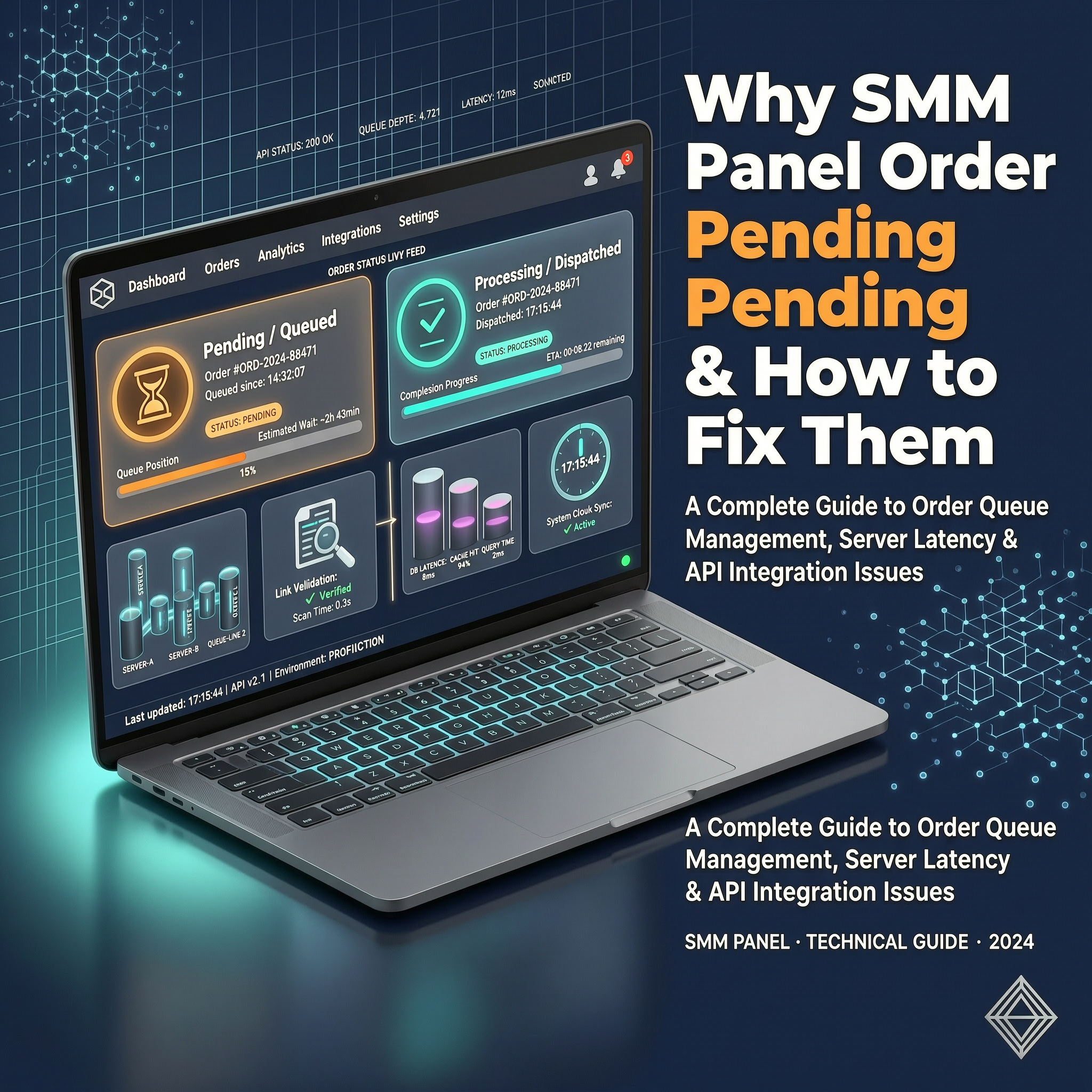
Why Is My SMM Panel Order Pending? 5 Root Causes, Server Queues & Quick Fixes (2026 Guide)
In programmatic social media marketing and automated reseller management, placing an order and watching it sit in "Pending" status for minutes or hours is one of the most common user concerns. Whether you are an individual creator waiting for engagement metrics to populate on a newly published post, a digital marketing agency executing multi-channel campaigns for enterprise clients, or a platform reseller managing thousands of client requests through an automated API, understanding what happens during the pending phase is vital for smooth operations.
Unlike a Canceled status (where an order is rejected due to invalid syntax or private account restrictions) or a Partial status (where delivery halts mid-stream due to capacity limits), a Pending status is not a failure. It is an intentional, automated staging phase where backend databases, queue worker daemons, and upstream server scrapers prepare, validate, and schedule your order for fulfillment.
This comprehensive 2026 technical guide explains the underlying engineering behind the SMM pending state. We analyze the 5 primary root causes of extended pending delays across major platforms (Instagram, YouTube, Facebook, X, Telegram, and LinkedIn), outline standard startup windows, detail the role of baseline Start Count scraping, and provide actionable standard operating procedures (SOPs) for both buyers and resellers to resolve stalled orders quickly.
To review live service startup speeds, execution rules, and real-time delivery limits, explore the SafeSMM Services Directory. Agencies and developers can review automated status endpoints via the SafeSMM API Documentation, and establish an account via the SafeSMM Registration Portal.
1. What Does "Pending" Actually Mean in an SMM Panel Backend?
When you click "Submit Order" on an SMM panel dashboard or send an action=add payload through a REST API, the order does not instantly appear on the target social media profile. SMM fulfillment is an asynchronous, multi-threaded server operation.
The Technical Definition of "Pending":
The Pending state confirms that your transaction has been accepted by the local database ledger, funds have been debited from your wallet, parameter validation (min/max thresholds) has passed, and the task has been placed into an asynchronous Redis/MySQL worker queue awaiting dispatch to the upstream delivery nodes.
During this stage, server worker daemons execute pre-flight checks: verifying that the target URL resolves over public DNS, checking that the destination account is accessible, and pinging public HTML endpoints to record the starting metric count.
For a complete foundational breakdown of how upstream aggregator backends communicate with source server networks, read our architectural overview on How SMM Panels Actually Work Behind the Scenes.
2. The 5 Order Stages: Pending vs. Processing vs. In Progress
To understand why an order remains in pending, you must distinguish between the standard operational states of an SMM order pipeline:
| Order Status | Backend State | Physical Delivery Action | Financial Status |
|---|---|---|---|
| Pending | Task queued in database; awaiting worker dispatch. | No metrics delivered yet. Scrapers checking URL. | Funds Held / Debited |
| Processing | Upstream node accepted API payload; start count logged. | Server allocating delivery workers and routing nodes. | Funds Deducted |
| In Progress | Delivery engine actively streaming interactions. | Counters actively increasing on public destination URL. | Funds Deducted |
| Completed | Target completion metric reached (Start Count + Quantity). | Delivery finished; monitoring for retention/refill. | Transaction Finalized |
| Partial / Canceled | Delivery halted prematurely or rejected at pre-flight. | Delivery stopped; unfulfilled units calculated. | Pro-rated or 100% Refund |
To understand how order states transition and how automated refunds operate when link errors occur, review our technical guide on SMM Panel Order Status Meanings & Balance Workflows.
3. Cause 1: Server Dispatch Queue Congestion & Ingestion Rate Limits
High-tier master SMM panels process tens of thousands of automated API requests every hour from global agencies, resellers, and direct buyers.
How Ingestion Queues Work:
To prevent database deadlocks and protect upstream delivery nodes from denial-of-service degradation, server architectures utilize asynchronous message brokers (such as RabbitMQ or Redis Queue).
- When thousands of orders enter the system simultaneously during peak global marketing hours (e.g., US evening hours, Black Friday campaigns, major holiday launches), incoming tasks are queued sequentially.
- Orders remain in
Pendingstatus while the worker daemons process preceding jobs in the FIFO (First-In, First-Out) pipeline. - Once the worker thread picks up your specific transaction identifier, the status immediately shifts to
ProcessingorIn Progress.
Queue latency is a natural characteristic of high-volume server infrastructures and typically resolves automatically within 15 to 45 minutes.
4. Cause 2: Baseline Metric Scraping (Start Count Latency)
Before an SMM panel can deliver a single follower, view, or like, it must establish an indisputable Start Count.
The Mathematical Necessity of the Start Count:
Target Completion Metric = Start Count + Ordered Quantity
If you order 2,500 YouTube views on a video with 1,000 views, the automated verification engine must record the initial 1,000 baseline count so it knows precisely when to terminate the order at 3,500 views.
Why Start Count Scraping Causes Pending Delays:
- Social Media CDN Caching: Major platforms (Instagram, YouTube, Facebook, X) distribute public counters across global Content Delivery Network (CDN) edge servers. If platform caching layers delay public metric visibility, provider scraper nodes must re-try fetching the public HTML data multiple times before locking the start count.
- Scraper Proxy Rotation: Provider nodes rotate through thousands of residential proxies to read public post counters without triggering platform rate-limits. If proxy handshakes experience momentary latency, the order remains in pending until a clean scraper handshake confirms.
5. Cause 3: Destination Account Privacy & Endpoint Resolution Blocks
SMM delivery networks operate exclusively using automated public scraping nodes. They cannot interact with content that requires login credentials, private access permissions, or age verification gates.
Common Privacy Triggers that Freeze Orders in Pending:
- Private Instagram Accounts: If an Instagram profile is set to Private, scraper nodes cannot read the current follower count or view published media, leaving the order stuck in pending until automated pre-flight filters cancel it.
- Age or Country Restrictions on Facebook / YouTube: If a Facebook page has age gates enabled (e.g., 18+ only) or a YouTube video has regional geographic restrictions, external scraper nodes located in other countries cannot resolve the link.
- Account Under Review or Temporary Flag: If a social platform temporarily places an account in a security checkpoint or review state, external public pings fail.
6. Cause 4: Link Formatting Errors & Query Parameter Pollution
Submitting a malformed URL or a link containing mobile tracking parameters frequently stalls automated queue processors.
Why Polluted Links Cause Pending Delays:
When links copied from mobile apps (such as https://instagram.com/reel/CXYZ123/?igsh=MWx1M... or https://youtu.be/XYZ123?si=AbCdEf...) are submitted, the automated regex parser must attempt to clean and sanitize the query parameters to identify the canonical post ID.
If the parser cannot cleanly resolve the target resource, the order sits in a pending validation queue until a secondary server routine either standardizes the URL format or rejects the order as Canceled with a full wallet refund.
To learn how to structure clean canonical URLs and prevent automated order rejections, consult our troubleshooting guide on Why SMM Panel Orders Get Canceled: 7 Causes & Fixes.
7. Cause 5: Upstream Server Maintenance & Platform Algorithmic Sweeps
Social media networks continuously deploy security patches, database optimizations, and anti-spam algorithm sweeps.
Defensive Server Pauses:
When an upstream provider detects that a social platform has rolled out a major backend update (e.g., altering Graph API response structures or modifying session token handshakes), continuing instant delivery using older delivery nodes risks triggering metric drops.
To protect customer profiles, provider panels temporarily pause specific Service ID queues. During these maintenance windows, newly placed orders hold safely in a Pending state until provider engineers update the delivery routing algorithms. Once verified, delivery resumes automatically.
To understand how quality service tiers and platform security updates impact delivery stability over time, explore our complete Social Media Retention & Drop Prevention Guide.
8. Normal Startup Windows Across Major Social Platforms (2026 Benchmarks)
Different social networks and service categories feature fundamentally different startup speed profiles. An order is not considered "delayed" until it exceeds its standard catalog startup window.
| Platform & Service Category | Standard Start Window | Extended / High-Load Window | Operational Delivery Characteristics |
|---|---|---|---|
| Instagram Likes / Post Views | 0 – 15 Minutes | 30 – 60 Minutes | Instant scraper handshake; fast node allocation. |
| Instagram High-Retention Followers | 15 – 45 Minutes | 1 – 3 Hours | Aged profile pool allocation with gradual velocity ramp-up. |
| YouTube High-Retention Views | 30 – 90 Minutes | 2 – 6 Hours | Pre-playback verification; distributed referral headers. |
| YouTube Channel Subscribers | 1 – 3 Hours | 6 – 12 Hours | Staggered drip delivery to mimic organic subscription patterns. |
| Facebook Page Likes / Followers | 30 – 60 Minutes | 2 – 4 Hours | Geographic demographic matching and profile filtering. |
| X (Twitter) Followers & Retweets | 15 – 45 Minutes | 1 – 3 Hours | Residential routing to comply with platform velocity limits. |
| Telegram Channel Members | 5 – 20 Minutes | 1 – 2 Hours | Direct API channel session joining; rapid startup. |
To compare execution speeds across budget and premium service tiers, review our analysis on Cheap SMM Panels With Fast Delivery: What to Check Before Buying.
9. Why Placing Duplicate Orders Makes Pending Delays Worse
When an order remains in pending for 30 minutes, impatient buyers often submit a second, identical order for the same link. This is the worst possible action to take.
The Counter Collision Problem:
If Order A is pending on a post with 500 likes, and you submit Order B for the same post, both orders scrape a Start Count of 500. When delivery initiates, the verification engines for both orders attempt to scrape and verify the delivered metrics simultaneously.
This collision causes verification failures, leading to one or both orders canceling prematurely, incorrect Partial status terminations, or unfulfilled units that cannot be tracked by automated refill algorithms.
The Golden Rule: Always wait until an active order on a specific URL reaches Completed, Partial, or Canceled status before submitting a new order for that same URL.
10. Step-by-Step Troubleshooting Protocol for Buyers
If your order has been in Pending status longer than the expected catalog startup window, follow this standardized 4-step diagnostic protocol:
- Step 1: Check Live Public Counter in Incognito Mode:
Social media mobile apps heavily cache data locally on your device. Open a private desktop browser window, visit the target public URL, and check if metrics have already begun populating. In many cases, delivery is actively streaming while the mobile app display lags behind.
- Step 2: Verify Public Privacy Settings:
Confirm that the target account has not been switched to Private, age-restricted, or country-blocked.
- Step 3: Review Catalog Service Notes:
Visit the SafeSMM Services Catalog, locate your Service ID, and check the description for any announcements regarding maintenance windows, speed adjustments, or queue updates.
- Step 4: Submit a Standardized Support Ticket:
If the startup window has elapsed and metrics have not started, open a quick support ticket containing your Order ID, Target URL, and Current Public Count. Avoid opening multiple duplicate tickets for the same transaction.
11. Reseller Blueprint: Managing Client Inquiries & Stalled API Orders
For digital marketing agencies, white-label child panels, and automated reseller storefronts, managing client expectations during pending states is critical for reducing support ticket volume and maintaining high retention.
1. Normalize Status Labels on Your Storefront:
Instead of displaying a cold "Pending" label on your retail dashboard, map upstream API statuses to reassuring, client-friendly terms such as "Queued in System" or "Preparing Delivery".
2. Standardized Support Response Template:
Customer Support Template: Order Pending Within Normal Startup Window
"Hello [Customer Name], thank you for reaching out. Your Order #[Order ID] is currently safely queued in our automated dispatch pipeline (Status: Preparing Delivery). This specific high-retention service features a standard startup window of [X] to [Y] minutes to allow our servers to establish an accurate baseline counter and ensure natural delivery velocity. Delivery will initiate shortly. Please ensure your target profile remains public during this time."
To learn how digital marketing agencies structure productized packages, monthly retainers, and client reporting, explore our comprehensive guide on SMM Reseller Business Guide: Pricing, Profit & Client Acquisition.
12. Developer Architecture: Cron Polling & Asynchronous Queue Optimization
If you are developing a custom WordPress/WooCommerce reseller storefront or CRM integration connecting to the SafeSMM API v2, handling pending orders efficiently requires proper polling architecture.
Best Practices for Developer Status Synchronization:
- Avoid High-Frequency Polling Loops: Never poll the
action=statusendpoint every 5 seconds for a pending order. Frequent polling provides zero delivery speed advantage and risks temporary IP rate-limiting. Schedule status cron jobs at 5-minute to 15-minute intervals. - Implement Status Timeouts in Local Databases: If an order remains in pending locally for over 12 hours without state change, configure your system to trigger an internal alert for administrative review.
- Batch Multiple Orders: When synchronizing multiple active orders, query multiple IDs simultaneously using comma-separated arrays (e.g.,
orders=101,102,103) to minimize HTTP overhead.
For complete code blueprints on integrating SMM APIs into WordPress and WooCommerce, read our dedicated technical guide on How to Connect SMM Panel API to WordPress & WooCommerce.
13. Frequently Asked Questions (FAQs)
1. How long can an SMM panel order stay in "Pending" status?
Under normal operating conditions, most orders stay pending for 5 to 45 minutes. Certain specialized high-retention services (such as YouTube watch time or gradual drip-feed packages) feature standard startup windows of 1 to 3 hours. Check the service description for specific timing benchmarks.
2. Does a "Pending" order mean my money was lost?
No. Your funds are safely held in your account ledger. If the provider server cannot fulfill the order due to link errors or maintenance, the system will automatically cancel the order and return 100% of your funds to your platform wallet balance.
3. Can I cancel an order while it is in "Pending" status?
Once an order is submitted and ingested into upstream dispatch queues, automated worker threads handle fulfillment. Cancellation is only possible if the service specifically supports manual cancellation or if the server pre-flight verification rejects the target link.
4. Why is my order pending while another order placed later already completed?
Different services run on independent server clusters and delivery queues. For example, high-speed post likes utilize rapid scraping nodes that start in minutes, while organic high-retention followers utilize staggered routing queues that require a longer startup window.
5. What happens if I change my username while an order is pending?
Changing your username while an order is pending breaks the destination endpoint URL. When the scraper node attempts to verify the link, it will encounter an HTTP 404 error, leading to an immediate order cancellation. Never change usernames during active orders.
6. Where can I check live service startup speeds and descriptions?
You can review live service requirements, start time estimates, and real-time tracking parameters in the SafeSMM Services Catalog.
14. Conclusion & Best Practices for Smooth Order Execution
A Pending status on an SMM panel is an essential, automated operational phase where server queues, scraper daemons, and delivery routing networks prepare your campaign for reliable fulfillment. Rather than indicating an error, it reflects active pre-flight verification designed to ensure metric accuracy and long-term retention.
By adhering to core pre-order hygiene—verifying 100% public visibility, utilizing clean canonical desktop URLs, respecting catalog startup windows, and avoiding concurrent duplicate orders on the same link—you can eliminate unnecessary delays and enjoy seamless, automated digital growth.
Experience High-Speed Automated Social Growth
Access raw wholesale pricing, high-speed REST APIs, 30-day refill guarantees, and 24/7 dedicated support.
Browse Wholesale Services Create Free Account