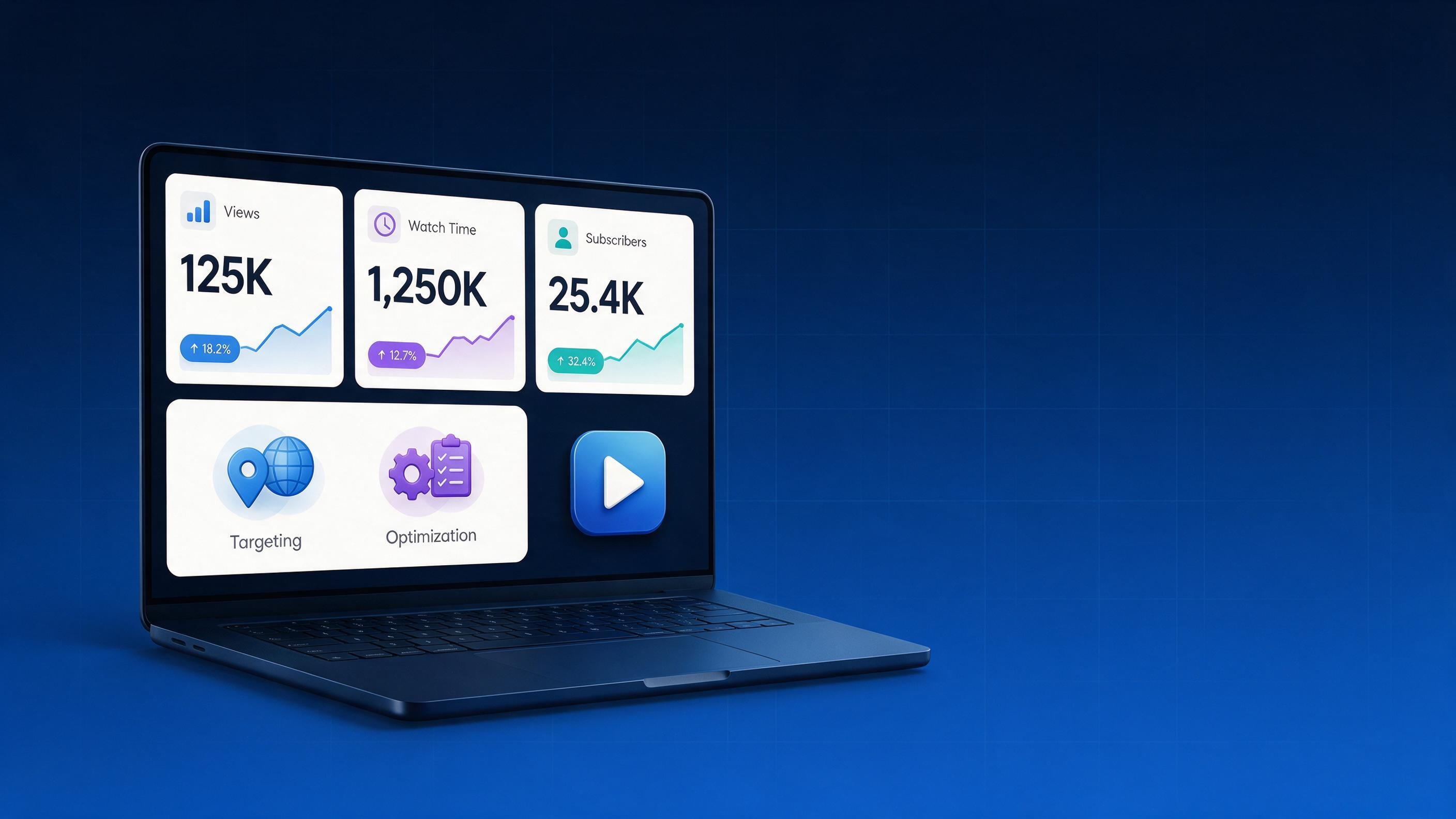
YouTube Promotion Services: Views, Watch Time & Subscriber Growth (2026 Guide)
Effective YouTube promotion services can help creators, businesses, musicians, educators, and agencies introduce their videos to a larger and more relevant audience. However, successful promotion is not simply about increasing a visible number. Sustainable channel growth depends on attracting the right viewers, earning meaningful watch time, improving content quality, and turning interested viewers into returning subscribers.
This guide explains the major YouTube promotion options available in 2026, including content optimization, official advertising, creator partnerships, external distribution, and third-party promotional support. It also shows you how to evaluate views, watch time, subscribers, targeting, pricing, and provider transparency before spending money.
You can review available promotional categories through SafeSMM Services. Before ordering, read every service description and review the Terms of Service. New users can create an account through the SafeSMM signup page.
Quick Answer: What Is YouTube Promotion?
YouTube promotion is the process of distributing, advertising, and optimizing a video or channel so that more relevant people can discover it. Depending on the campaign, promotion may include YouTube SEO, official video advertising, creator collaborations, social distribution, email marketing, community outreach, or carefully evaluated third-party services.
A professional campaign should support one or more measurable objectives:
- Introducing a new video to a relevant audience
- Increasing qualified video views
- Improving average view duration and total watch time
- Generating returning viewers and genuine subscribers
- Driving website visits, leads, sales, or app downloads
- Building awareness in selected countries or language markets
Promotion cannot repair weak content. If viewers leave immediately, additional distribution may increase impressions without creating meaningful growth. The best campaigns combine attractive videos, clear positioning, audience targeting, and reliable measurement.
How YouTube Channel Growth Actually Works
YouTube recommends videos when its systems believe viewers are likely to choose and appreciate them. A campaign may bring initial visitors, but viewer behavior influences what happens next. Important signals include click-through rate, watch duration, satisfaction, returning viewers, comments, shares, and whether people continue watching other videos.
Impressions and click-through rate
An impression occurs when a thumbnail is shown in an eligible YouTube location. Click-through rate measures how often viewers select the video after seeing that thumbnail. A clear title and compelling thumbnail can improve clicks, but they must accurately represent the content. Misleading thumbnails may attract initial clicks while producing low retention and negative feedback.
Audience retention and watch duration
Retention shows how long viewers remain engaged. A video with fewer views but strong retention can be more valuable than one with many low-quality visits. The opening should confirm the promise made by the title, avoid unnecessary introductions, and give viewers a reason to continue.
Viewer satisfaction and returning viewers
Likes and comments provide context, but long-term channel strength comes from people who voluntarily return. A consistent topic, recognizable presentation style, useful playlists, and relevant follow-up videos make it easier to convert one-time viewers into a real audience.
Types of YouTube Promotion Services
The term “YouTube promotion service” covers several different methods. They do not provide identical traffic quality, control, or business value, so understand the differences before choosing one.
1. YouTube SEO and content optimization
YouTube SEO helps the platform and viewers understand a video. It includes topic research, titles, descriptions, chapters, captions, playlists, and internal links between related videos. SEO is relatively slow, but it can continue producing discovery after a paid campaign ends.
A good optimization service should study audience intent instead of inserting the same keyword repeatedly. The primary phrase belongs naturally in the title and opening description, while supporting terms can be covered in chapters and spoken content.
2. Official YouTube and Google video advertising
Official video advertising allows advertisers to target audiences by location, language, interests, topics, placements, and other available options. It is useful for launches, brand awareness, remarketing, and website conversion campaigns because spending and targeting can be controlled from an advertising account.
Advertising views do not automatically create loyal subscribers. Campaigns perform best when the video has a clear hook, a suitable audience, and a specific next action. Always confirm the latest eligibility and monetization rules because not every type of paid watch activity counts in the same way.
3. Creator collaborations and sponsorships
Collaborations place your content in front of an established audience. A relevant smaller channel may deliver better engagement than an unrelated large channel. The strongest partnerships have topic alignment, audience trust, transparent sponsorship disclosure, and a natural reason for viewers to visit your channel.
4. External content distribution
Videos can be promoted through websites, newsletters, communities, social profiles, forums, and digital publications. External traffic is most useful when the audience is already interested in the topic. Posting links everywhere without context is spam and normally produces weak retention.
5. Third-party promotional services
Third-party services may offer distribution or engagement-related options. Quality varies significantly, so buyers must check the traffic source, delivery method, targeting, retention terms, and provider policies. A visible metric alone does not prove audience quality or business impact.
Before using any third-party option, confirm that it requires only a public video or channel URL. Avoid services requesting login credentials, browser cookies, recovery codes, or private access. Review the complete description in the SafeSMM service catalog before placing an order.
| Promotion Method | Primary Strength | Main Limitation | Best Use |
|---|---|---|---|
| YouTube SEO | Long-term discovery | Results can take time | Evergreen educational and search-led content |
| Official video ads | Targeting and budget control | Traffic may stop when spending stops | Launches, awareness, leads, and remarketing |
| Creator collaborations | Audience trust | Good partners can be expensive | Niche authority and relevant subscribers |
| External distribution | Reaches existing communities | Quality depends on audience relevance | Newsletters, websites, and community campaigns |
| Third-party services | Convenient campaign support | Quality and policy compliance vary | Small, carefully reviewed promotional tests |
Views vs Watch Time vs Subscribers: What Should You Prioritize?
YouTube views
Views show that a video received plays recognized by YouTube, but they do not reveal whether viewers were relevant, satisfied, or likely to return. When analyzing views, also check traffic source, average view duration, geography, device type, and actions taken after watching.
YouTube watch time
Watch time measures the total time viewers spend watching. It is influenced by both view volume and average duration. Increasing meaningful watch time usually requires a strong opening, focused editing, clear structure, and videos that match viewer intent.
Be careful with any service claiming guaranteed monetization watch hours. YouTube evaluates valid activity and may exclude traffic that does not qualify. Monetization also depends on policy compliance, channel review, and the current YouTube Partner Program requirements. Promotion should never be presented as a shortcut around those requirements.
YouTube subscriber growth
Subscribers are most valuable when they voluntarily choose the channel and continue watching. A large subscriber number with very few returning viewers can create poor audience quality and unrealistic expectations. Encourage subscriptions after demonstrating value, and tell viewers what future content they will receive.
Which metric is best?
The correct priority depends on the campaign. A new product launch may prioritize relevant reach and website conversions. An educational channel may prioritize retention, returning viewers, and playlist continuation. An agency may report views, but it should also show whether those views produced qualified actions.
Step-by-Step YouTube Promotion Plan
Step 1: Define one primary campaign objective
Avoid goals such as “make the channel famous.” Choose a measurable objective: generate 1,000 relevant video visitors, improve qualified website traffic, introduce a new series, or test demand in a target country. One clear objective makes budget and reporting decisions easier.
Step 2: Identify the target viewer
Define the viewer’s country, language, interests, problem, and reason for watching. For global campaigns, one broad worldwide audience is often less effective than several smaller language or regional segments. Different audiences may need different titles, captions, examples, and calls to action.
Step 3: Audit the channel before promotion
Check whether the channel looks complete and trustworthy. Review the profile image, banner, About section, featured video, playlists, thumbnails, and recent upload consistency. Promotion can bring visitors, but an incomplete channel may fail to convert them.
Step 4: Choose the right video
Do not automatically promote the newest upload. Select a video with a clear topic, strong opening, useful information, and a logical next step. If several videos cover the same subject, promote the one already showing better retention or conversion data.
Step 5: Improve the title and thumbnail
The title should promise a specific benefit without exaggeration. The thumbnail should remain readable on mobile screens, use a clear visual hierarchy, and avoid too much text. Test alternatives when enough impressions are available, but change one important variable at a time.
Step 6: Optimize the viewing experience
Remove unnecessary introductions, confirm the video’s promise early, and use chapters for longer videos. Add accurate captions for accessibility and global reach. Link to one relevant next video through cards, end screens, descriptions, and a pinned comment where appropriate.
Step 7: Select a promotion method
Match the method to the objective. Use official ads when you need targeting and controlled spending. Use collaborations when audience trust matters. Use SEO for long-term discovery. If evaluating a third-party service, start with a small order and review its description, limitations, and terms.
Step 8: Set a controlled test budget
Divide the total budget into testing and scaling phases. For example, use a limited portion to compare audiences, creatives, or services. Move additional budget only toward options that produce relevant watch behavior or business results. Never make a large first deposit based only on promotional claims.
Step 9: Record a baseline
Before starting, record current views, watch time, average view duration, retention, subscribers, traffic sources, and conversions. Without baseline data, you cannot distinguish campaign impact from normal channel activity.
Step 10: Monitor quality during the campaign
Look beyond total views. Check whether traffic comes from expected countries, whether viewers stay beyond the opening, and whether returning viewers increase. Stop or adjust campaigns that produce abnormal patterns, poor retention, irrelevant geography, or no useful downstream action.
Step 11: Optimize and scale carefully
Keep the successful elements and change weak ones. If click-through rate is low, test the title or thumbnail. If clicks are strong but retention is weak, improve the video opening and audience match. If watch behavior is good but conversions are low, improve the offer and call to action.
Step 12: Build a content path after the promoted video
A promoted video should lead somewhere. Create a related playlist, follow-up video, website resource, or email signup. This helps turn temporary campaign attention into an owned audience and gives interested viewers a reason to continue engaging with your brand.
How to Evaluate a YouTube Promotion Provider
A trustworthy provider should explain what is being offered without making impossible guarantees. Use this checklist before purchasing:
- Public-link ordering: only the relevant public video or channel URL should be required.
- Clear service information: minimum, maximum, expected start window, delivery range, and important restrictions.
- Traffic transparency: the provider should not misrepresent automated activity as real fans or guaranteed customers.
- Realistic claims: no guaranteed rankings, viral success, permanent retention, or monetization approval.
- Order tracking: customers should receive an order ID and understandable status updates.
- Published terms: refund, cancellation, partial-delivery, and customer-error conditions should be visible.
- Accessible support: there should be a clear channel for delayed or incorrect orders.
- Small testing option: buyers should be able to evaluate services before scaling.
Red flags to avoid
- Requests for your Google password, cookies, or verification codes
- Claims that purchased activity is guaranteed to pass monetization review
- No service descriptions, terms, support process, or order tracking
- Pressure to make a large deposit immediately
- Promises of millions of real viewers at an implausibly low price
- No explanation of partial delivery, refunds, or possible removals
For additional provider research, read SMM Panel Reviews. Agencies evaluating wholesale fulfillment can also review the Best Reseller SMM Panel guide.
YouTube Promotion Pricing and Campaign Budget
Pricing varies according to promotion method, audience location, competition, targeting, service quality, and campaign objective. Official advertising normally uses an auction model, while agencies may charge a management fee, a fixed package price, or a percentage of advertising spend. Third-party service pricing may be displayed per 1,000 units.
Compare cost against useful outcomes rather than visible numbers alone. A campaign costing more but attracting relevant viewers and customers can provide better value than a cheap campaign with poor retention.
| Budget Area | Suggested Purpose | What to Measure |
|---|---|---|
| Content and creative | Video editing, thumbnail, captions | Click-through rate and retention |
| Distribution | Ads, partnerships, or promotion | Relevant views and watch quality |
| Testing | Compare audiences and creatives | Cost per qualified action |
| Optimization | Improve winning campaigns | Conversions and returning viewers |
How to Measure YouTube Promotion Results
YouTube Analytics should be the primary measurement source. Provider dashboards can report order progress, but they cannot replace channel-level performance data.
Metrics worth tracking
- Impressions: how often eligible thumbnails were displayed
- Click-through rate: how effectively titles and thumbnails earned clicks
- Average view duration: average time watched per view
- Audience retention: where viewers continued or left
- Traffic sources: search, browse, suggested, ads, or external sources
- Unique and returning viewers: whether the channel is building an audience
- Subscriber conversion: subscriptions generated relative to qualified viewers
- Business outcomes: leads, sales, signups, downloads, or website engagement
Review results by traffic source and country. Averages can hide problems. For example, one source may create high retention while another produces many short visits. Use that insight to improve the next campaign.
How to Reach a Global YouTube Audience
Global promotion does not mean showing every video to everyone. Start with markets where your language, topic, pricing, and offer are relevant. English can reach multiple countries, but captions, translations, and localized examples can improve accessibility and trust.
- Create accurate English captions and consider translated subtitles for priority markets.
- Review viewer activity times instead of publishing for one local time zone only.
- Use topics with international relevance and explain local terms when necessary.
- Segment campaigns by country or language so performance can be compared properly.
- Make landing pages mobile-friendly and support payment methods appropriate for your customers.
Avoid buying broad “worldwide” traffic merely because it is cheap. Relevance is more valuable than geographic volume. A smaller audience that understands the content is more likely to watch, return, and convert.
YouTube Promotion for Agencies and Resellers
Agencies need more than individual orders. They need repeatable service descriptions, wholesale pricing, status tracking, and clear client reporting. If you resell promotional services, disclose realistic limitations and never promise outcomes that the upstream provider cannot guarantee.
API access can automate catalog imports, order submission, balance checks, and status synchronization. Agencies can review the SafeSMM API page and compare related services before building an automated workflow.
Keep customer-facing reports simple: campaign objective, selected service, start date, delivery status, YouTube Analytics results, and next recommendation. Separate delivered quantities from business outcomes so clients understand what was purchased and what was actually achieved.
Common YouTube Promotion Mistakes
- Promoting weak content: distribution cannot fix an unclear or low-retention video.
- Choosing volume over relevance: cheap, unrelated traffic rarely builds a useful audience.
- Buying without testing: begin with a limited campaign before increasing spending.
- Focusing on subscribers alone: returning viewers and watch behavior matter more than a decorative number.
- Ignoring analytics: campaign dashboards do not replace YouTube Analytics.
- Expecting guaranteed monetization: eligibility depends on valid activity, current requirements, and channel review.
- Sharing account credentials: legitimate link-based promotion does not need your password.
- Using misleading titles or thumbnails: this can produce clicks but damage retention and trust.
Frequently Asked Questions
1. What are YouTube promotion services?
They are services or methods used to distribute and optimize YouTube videos. Examples include YouTube SEO, official video advertising, creator collaborations, external distribution, and third-party promotional support.
2. Can a promotion service guarantee viral growth?
No. Virality depends on content quality, audience response, timing, competition, and recommendation systems. Avoid providers guaranteeing a specific ranking or viral outcome.
3. Do promoted views count toward monetization?
Not every traffic source or type of paid activity qualifies in the same way. YouTube evaluates valid activity and current program requirements. Check official YouTube guidance before making monetization decisions.
4. Can promotion increase YouTube watch time?
Relevant distribution can increase watch time when viewers genuinely watch the content. However, watch time quality depends on audience match, retention, and traffic validity. No provider should guarantee monetization watch hours.
5. How can I gain more genuine subscribers?
Publish consistently around a clear topic, improve retention, create related series, explain the benefit of subscribing, and promote videos to audiences already interested in the subject.
6. Is a cheap YouTube promotion service worth using?
Only if its delivery method, limitations, and terms are clear. Begin with a small test and evaluate traffic sources, retention, geography, and support rather than judging price alone.
7. Should I share my YouTube password with a provider?
No. Public-link promotion should not require a Google password, cookies, recovery code, or two-factor authentication code. Credential requests are a serious security warning.
8. How long does YouTube promotion take?
It depends on the method. Official ads may begin after campaign review, SEO may take weeks or months, and creator partnerships depend on publishing schedules. Third-party services should provide an estimated start and completion range.
9. What should I check before ordering?
Check service requirements, minimum and maximum quantities, start window, delivery expectations, traffic description, possible retention terms, partial-delivery rules, refund conditions, and provider support.
10. What is the best YouTube promotion strategy in 2026?
The strongest approach combines useful content, accurate titles and thumbnails, YouTube SEO, carefully targeted distribution, channel-level analytics, and continuous optimization. Promotion should support a content strategy rather than replace it.
Conclusion: Choose Relevant Growth Over Empty Numbers
YouTube promotion services can support discovery, but the best results come from combining promotion with strong content, relevant targeting, transparent measurement, and realistic expectations. Views can introduce a video, watch time can indicate attention, and subscribers can support future distribution—but none of these metrics should be evaluated in isolation.
Start with a clear objective, audit the video, choose a suitable promotional method, establish baseline analytics, and test with a controlled budget. Never share account credentials or rely on guarantees of monetization, permanent retention, rankings, or viral success.