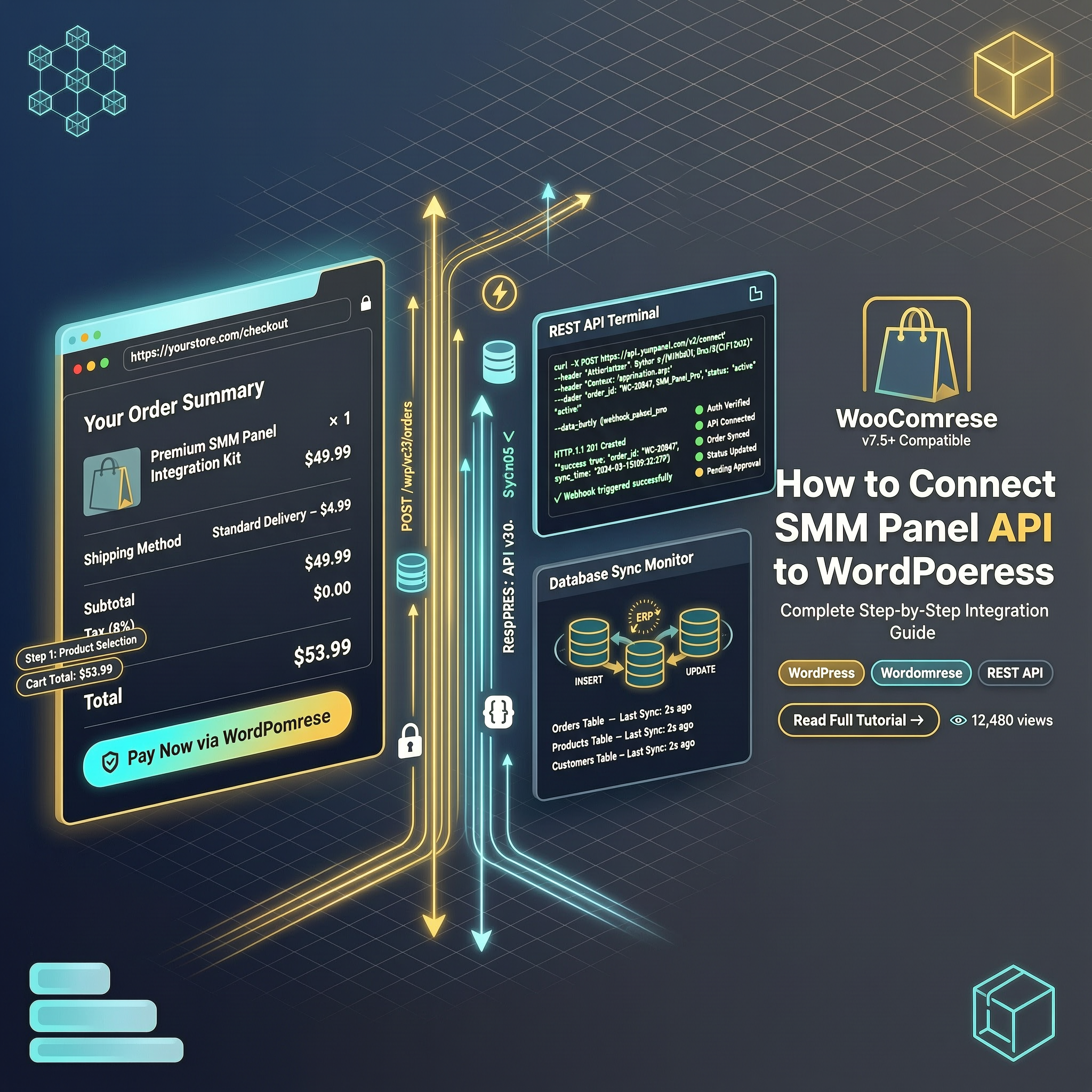
How to Connect SMM Panel API to WordPress & WooCommerce: Step-by-Step Developer Blueprint (2026 Guide)
Operating an automated social media marketing storefront allows digital marketing agencies, freelancers, and entrepreneurs to sell digital growth services directly to global clients under their own independent branding. While turnkey reseller scripts and child panels offer quick deployments, building an SMM reseller storefront on WordPress and WooCommerce provides unmatched enterprise flexibility: complete control over UI/UX design, integration with hundreds of international payment processors, custom customer billing portals, advanced search engine optimization (SEO) capabilities, and complete ownership of your relational customer database.
The core operational engine of an automated WordPress SMM platform is the REST API bridge. When a customer purchases a package—such as high-retention video views, profile followers, or post reactions—on your WooCommerce checkout page, your server must programmatically capture the order metadata, sanitize the target public link, dispatch an outbound HTTP POST request to your upstream master provider, store the provider’s transaction identifier, and periodically synchronize status updates back to the customer's dashboard.
This comprehensive technical blueprint provides an end-to-end, production-ready guide to integrating an SMM panel API with WordPress and WooCommerce in 2026. We cover architectural planning, custom product meta field injection, native PHP cURL dispatch hooks using wp_remote_post(), automated WP-Cron status polling daemons, idempotency safeguards to prevent accidental double-billing, and enterprise-grade security hardening.
To review live service endpoint parameters, pricing tiers, and JSON response structures, explore the SafeSMM Services Catalog. Developers can review raw API documentation via the SafeSMM API v2 Reference, and establish an automated provider workspace on the SafeSMM Registration Portal.
1. System Architecture: How WordPress Communicates with an SMM API
Before writing code or configuring database hooks, developers must understand the transactional state machine governing the interaction between WordPress, WooCommerce checkout events, your local MySQL database, and the upstream SMM provider.
The 6-Phase Automated Order Lifecycle:
- Frontend Parameter Ingestion: A client visits your WooCommerce store, selects a virtual service product (e.g., "High-Retention YouTube Views"), inputs their public target URL (e.g.,
https://youtube.com/watch?v=XYZ123), selects a quantity (e.g.,5,000), and proceeds to checkout. - Payment Verification & Order State Transition: The customer completes payment via your integrated gateway (Stripe, PayPal, Crypto). Upon payment capture, WooCommerce transitions the order status from
Pending PaymenttoProcessing. - Outbound API Dispatch Hook: An asynchronous action hook attached to
woocommerce_order_status_processingintercepts the transition event, extracts the order line item metadata, retrieves the corresponding upstream Service ID, and constructs an encrypted HTTP POST payload. - Upstream Handshake & Order ID Capture: The master provider API validates the authentication key, checks your master wallet balance, verifies the target URL format, scrapes the baseline Start Count, and returns a JSON payload containing the upstream provider order ID (e.g.,
{"order": 9876543}). - Metadata Binding & State Flagging: Your WordPress backend stores the returned upstream Order ID, initial Start Count, and execution status into the
woocommerce_order_itemmetatable and appends a structured order note. - Asynchronous Cron Status Synchronization: A server-side cron job executes every 5 to 15 minutes, querying the provider’s
action=statusendpoint in batches, updating dynamic counters (remains), and resolving the WooCommerce order toCompletedorPartially Completedonce fulfillment concludes.
For a complete conceptual breakdown of upstream server handling, queue mechanics, and provider supply chains, explore our foundational guide on How SMM Panels Actually Work Behind the Scenes.
2. Server Environment & Hosting Prerequisites
High-volume reseller storefronts process dozens of simultaneous checkout transactions, asynchronous status polling daemons, and database read/write operations. To prevent connection timeouts and memory exhaustion, your hosting environment must meet the following production standards:
| System Component | Minimum Baseline Requirement | Recommended Enterprise Standard |
|---|---|---|
| PHP Version | PHP 8.0+ | PHP 8.2 or PHP 8.3 with OPcache enabled |
| PHP Extensions | cURL, JSON, OpenSSL, mbstring |
cURL (HTTP/2 enabled), libxml, Redis / Memcached |
| PHP Memory Limit | 256 MB (WP_MEMORY_LIMIT) |
512 MB dedicated memory |
| Maximum Execution Time | 60 seconds | 120–300 seconds for background cron workers |
| Database Engine | MySQL 5.7+ / MariaDB 10.3+ | MariaDB 10.6+ or MySQL 8.0 with InnoDB Engine |
| WordPress Cron Model | Virtual WP-Cron | Server-Level System Crontab (Linux / cPanel Cron) |
define('DISABLE_WP_CRON', true); inside your wp-config.php file, and configure a true system crontab executing every 5 minutes:
*/5 * * * * wget -q -O - https://yourdomain.com/wp-cron.php?doing_wp_cron >/dev/null 2>&1
3. Architectural Decision: Pre-Built Plugins vs. Native Custom Code
When building a WordPress SMM reseller storefront, you must choose between using third-party commercial plugins or developing a native custom PHP integration module.
Option A: Commercial WordPress SMM Plugins
Third-party plugins offer visual administrative interfaces for setting API keys, importing service catalogs, and mapping products.
- Pros: Fast initial setup; visual UI for non-developers; automated service catalog import tools.
- Cons: Ongoing annual license fees; heavy database footprints; security vulnerabilities from third-party codebases; slow updates when upstream provider APIs evolve.
Option B: Native Custom PHP Architecture (Recommended)
Engineering a dedicated custom integration via a lightweight site-specific plugin or your child theme’s functions.php provides complete architectural independence.
- Pros: 100% lightweight; zero unnecessary database queries or external asset loading; full control over error handling, retries, and custom email notifications; zero ongoing software licensing costs; easily adaptable to multiple upstream providers.
- Cons: Requires working familiarity with PHP, WordPress Action Hooks, and WooCommerce order metadata structures.
If you are building an agency model with custom branding and recurring client retainers, review our strategic guide on White Label SMM Panels Explained: How Agencies Scale in 2026.
4. Configuring WooCommerce Virtual Products & Custom Input Fields
SMM services are digital, non-physical offerings. Configuring them properly in WooCommerce eliminates physical shipping calculations, address fields, and unnecessary checkout friction.
1. Product Base Setup
- Product Type: Select Simple Product (or Variable Product for tiered quantity bundles).
- Virtual Checkbox: Check the Virtual checkbox. This disables shipping address requirements during checkout.
- Inventory Management: Set Inventory to In Stock and disable stock tracking.
- Catalog Visibility: Organize products into clean platform categories (e.g., Instagram Growth, YouTube Engagement, Facebook Services).
2. Storing the Upstream Service ID in Product Meta
Every WooCommerce product must store its corresponding upstream Service ID. You can add a custom meta box to the WooCommerce product editor using this clean PHP snippet:
// 1. Add Custom Service ID Field to WooCommerce Product General Settings
add_action('woocommerce_product_options_general_product_data', 'safesmm_add_custom_service_id_field');
function safesmm_add_custom_service_id_field() {
    echo '<div class="options_group">';
    woocommerce_wp_text_input(array(
        'id'          => '_safesmm_service_id',
        'label'       => __('SafeSMM Service ID', 'woocommerce'),
        'placeholder' => 'e.g. 1024',
        'desc_tip'    => 'true',
        'description' => __('Enter the exact numeric Service ID from the SafeSMM catalog.', 'woocommerce'),
        'type'        => 'number'
    ));
    echo '</div>';
}

// 2. Save the Custom Service ID Field when Product is Saved
add_action('woocommerce_process_product_meta', 'safesmm_save_custom_service_id_field');
function safesmm_save_custom_service_id_field($post_id) {
    $service_id = isset($_POST['_safesmm_service_id']) ? sanitize_text_field($_POST['_safesmm_service_id']) : '';
    update_post_meta($post_id, '_safesmm_service_id', $service_id);
}
5. Capturing, Sanitizing & Passing the Target URL at Checkout
To fulfill an order, the upstream API requires the customer's public target link. You must inject a required URL input field directly onto the product page, validate the input string, pass it through the WooCommerce cart session, and bind it to the final order item metadata.
// 1. Render the Target URL Input Field on the Single Product Page
add_action('woocommerce_before_add_to_cart_button', 'safesmm_render_target_url_input', 10);
function safesmm_render_target_url_input() {
    global $product;
    $service_id = get_post_meta($product->get_id(), '_safesmm_service_id', true);

    // Only render input field if product has a mapped Service ID
    if (empty($service_id)) return;

    echo '<div class="safesmm-url-input-wrapper" style="margin: 15px 0;">';
    echo '<label for="safesmm_target_link" style="display:block; font-weight:bold; margin-bottom:5px;">Target Public URL (Post / Profile / Channel): <span style="color:red;">*</span></label>';
    echo '<input type="url" id="safesmm_target_link" name="safesmm_target_link" placeholder="https://..." required style="width:100%; max-width:450px; padding:8px; border:1px solid #ccc; border-radius:4px;" />';
    echo '<small style="display:block; color:#666; margin-top:4px;">Please ensure the target account or post is set to 100% Public.</small>';
    echo '</div>';
}

// 2. Validate the Submitted URL before Adding to Cart
add_filter('woocommerce_add_to_cart_validation', 'safesmm_validate_target_url_input', 10, 3);
function safesmm_validate_target_url_input($passed, $product_id, $quantity) {
    $service_id = get_post_meta($product_id, '_safesmm_service_id', true);
    if (!empty($service_id)) {
        if (empty($_POST['safesmm_target_link']) || !filter_var($_POST['safesmm_target_link'], FILTER_VALIDATE_URL)) {
            wc_add_notice(__('Please provide a valid, complete public target URL (starting with https://).', 'woocommerce'), 'error');
            return false;
        }
    }
    return $passed;
}

// 3. Store the Target URL in Cart Item Session Data
add_filter('woocommerce_add_cart_item_data', 'safesmm_store_target_url_in_cart', 10, 2);
function safesmm_store_target_url_in_cart($cart_item_data, $product_id) {
    if (isset($_POST['safesmm_target_link'])) {
        $cart_item_data['safesmm_target_link'] = esc_url_raw($_POST['safesmm_target_link']);
    }
    return $cart_item_data;
}

// 4. Transfer Cart Item Data into Permanent Order Item Metadata
add_action('woocommerce_checkout_create_order_line_item', 'safesmm_bind_target_url_to_order_item', 10, 4);
function safesmm_bind_target_url_to_order_item($item, $cart_item_key, $values, $order) {
    if (isset($values['safesmm_target_link'])) {
        $item->add_meta_data('_safesmm_target_link', $values['safesmm_target_link'], true);
        // Add human-readable label for customer invoices
        $item->add_meta_data(__('Target Link', 'woocommerce'), $values['safesmm_target_link'], true);
    }
}
6. Engineering the Automated PHP API Dispatch Engine
Once payment is confirmed and the order transitions to Processing, your custom backend hook extracts the parameters, builds the payload, and dispatches the HTTP POST request to the SafeSMM endpoint.
// Hook into WooCommerce Paid / Processing Order Status
add_action('woocommerce_order_status_processing', 'safesmm_dispatch_automated_api_orders', 10, 1);

function safesmm_dispatch_automated_api_orders($order_id) {
    $order = wc_get_order($order_id);
    if (!$order) return;

    // Idempotency: Prevent duplicate dispatch if already executed
    if ($order->get_meta('_safesmm_dispatch_status') === 'completed') {
        return;
    }

    // Set lock flag to prevent concurrent executions
    $order->update_meta_data('_safesmm_dispatch_status', 'in_progress');
    $order->save();

    // API Configuration
    $api_url = 'https://safesmm.net/api/v2';
    $api_key = defined('SAFESMM_API_KEY') ? SAFESMM_API_KEY : '';

    if (empty($api_key)) {
        $order->add_order_note(__('SafeSMM API Error: API Key is not configured in wp-config.php.', 'woocommerce'));
        return;
    }

    $all_dispatched_successfully = true;

    foreach ($order->get_items() as $item_id => $item) {
        $product = $item->get_product();
        if (!$product) continue;

        $service_id = $product->get_meta('_safesmm_service_id');
        $target_link = $item->get_meta('_safesmm_target_link');
        $quantity = $item->get_quantity();

        // Skip items that are not automated SMM products
        if (empty($service_id) || empty($target_link)) {
            continue;
        }

        // Check if item was already dispatched previously
        if (!empty($item->get_meta('_safesmm_upstream_order_id'))) {
            continue;
        }

        // Construct Encrypted POST Payload
        $payload = array(
            'key'      => $api_key,
            'action'   => 'add',
            'service'  => intval($service_id),
            'link'     => esc_url_raw($target_link),
            'quantity' => intval($quantity)
        );

        // Dispatch HTTP Request via WordPress HTTP API Wrapper
        $response = wp_remote_post($api_url, array(
            'method'      => 'POST',
            'timeout'     => 45,
            'redirection' => 5,
            'httpversion' => '1.1',
            'blocking'    => true,
            'headers'     => array(
                'Accept'       => 'application/json',
                'Content-Type' => 'application/x-www-form-urlencoded'
            ),
            'body'        => $payload,
        ));

        // Handle Transport & Network Errors
        if (is_wp_error($response)) {
            $error_message = $response->get_error_message();
            $order->add_order_note(sprintf(__('SafeSMM API Network Error on Item #%d: %s', 'woocommerce'), $item_id, $error_message));
            $all_dispatched_successfully = false;
            continue;
        }

        $response_code = wp_remote_retrieve_response_code($response);
        $body = wp_remote_retrieve_body($response);
        $data = json_decode($body, true);

        if ($response_code === 200 && isset($data['order'])) {
            // Success: Capture Upstream Order ID
            $upstream_order_id = sanitize_text_field($data['order']);
            $item->update_meta_data('_safesmm_upstream_order_id', $upstream_order_id);
            $item->update_meta_data('_safesmm_status', 'pending');
            $item->save();

            $order->add_order_note(sprintf(
                __('SafeSMM Dispatch Success! Upstream Order ID: #%s (Service ID: %d, Quantity: %d)', 'woocommerce'),
                $upstream_order_id,
                $service_id,
                $quantity
            ));
        } else {
            // Handle Upstream Parameter / Balance Errors
            $error_details = isset($data['error']) ? $data['error'] : 'Unknown HTTP ' . $response_code . ' response.';
            $order->add_order_note(sprintf(__('SafeSMM Dispatch Failed for Item #%d. Error: %s', 'woocommerce'), $item_id, $error_details));
            $all_dispatched_successfully = false;
        }
    }

    // Finalize Order Dispatch Meta
    if ($all_dispatched_successfully) {
        $order->update_meta_data('_safesmm_dispatch_status', 'completed');
    } else {
        $order->update_meta_data('_safesmm_dispatch_status', 'partial_failure');
    }
    $order->save();
}
For detailed explanations of JSON error payload structures and troubleshooting protocols, read our companion guide on SMM Panel API Error Codes & Troubleshooting.
7. Database Schema & WooCommerce Order Metadata Mapping
Maintaining structured metadata across native WooCommerce tables ensures high query performance and seamless compatibility with customer account dashboards.
| Meta Key Name | Database Location | Data Type | Operational Function |
|---|---|---|---|
_safesmm_service_id |
wp_postmeta |
Integer | Maps the WooCommerce product to the exact upstream catalog service ID. |
_safesmm_target_link |
woocommerce_order_itemmeta |
String (URL) | Stores the customer's public target URL submitted during product configuration. |
_safesmm_upstream_order_id |
woocommerce_order_itemmeta |
Integer / String | The unique transaction primary key returned by the upstream provider. |
_safesmm_status |
woocommerce_order_itemmeta |
String | Tracks dynamic fulfillment status (pending, in progress, completed, partial). |
_safesmm_start_count |
woocommerce_order_itemmeta |
Integer | Baseline metric count scraped by provider prior to delivery initiation. |
_safesmm_remains |
woocommerce_order_itemmeta |
Integer | Number of unfulfilled units remaining during dynamic status polling. |
8. Building the Automated Status Sync Engine via WP-Cron
Once orders are dispatched, your system must periodically poll the upstream provider API to track delivery progress. This eliminates manual customer support checks and keeps your WooCommerce dashboard synchronized.
// 1. Register a 5-Minute Recurring Interval in WP-Cron
add_filter('cron_schedules', 'safesmm_register_cron_interval');
function safesmm_register_cron_interval($schedules) {
    $schedules['safesmm_five_minutes'] = array(
        'interval' => 300,
        'display'  => __('Every 5 Minutes', 'woocommerce')
    );
    return $schedules;
}

// 2. Schedule the Event on System Boot
if (!wp_next_scheduled('safesmm_cron_status_sync_hook')) {
    wp_schedule_event(time(), 'safesmm_five_minutes', 'safesmm_cron_status_sync_hook');
}

// 3. Attach Worker Function to the Cron Hook
add_action('safesmm_cron_status_sync_hook', 'safesmm_execute_status_sync_worker');

function safesmm_execute_status_sync_worker() {
    $api_url = 'https://safesmm.net/api/v2';
    $api_key = defined('SAFESMM_API_KEY') ? SAFESMM_API_KEY : '';
    if (empty($api_key)) return;

    // Fetch up to 50 active processing orders to avoid PHP timeouts
    $orders = wc_get_orders(array(
        'status' => array('processing'),
        'limit'  => 50,
        'return' => 'objects',
    ));

    if (empty($orders)) return;

    foreach ($orders as $order) {
        $order_id = $order->get_id();
        $all_items_finished = true;
        $has_active_smm_items = false;

        foreach ($order->get_items() as $item_id => $item) {
            $upstream_id = $item->get_meta('_safesmm_upstream_order_id');
            $current_status = $item->get_meta('_safesmm_status');

            if (empty($upstream_id)) continue;
            $has_active_smm_items = true;

            // Skip items that already reached terminal states
            if (in_array($current_status, array('completed', 'partial', 'canceled', 'refunded'))) {
                continue;
            }

            // Query Provider Status Endpoint
            $response = wp_remote_post($api_url, array(
                'method'  => 'POST',
                'timeout' => 30,
                'body'    => array(
                    'key'    => $api_key,
                    'action' => 'status',
                    'order'  => intval($upstream_id)
                )
            ));

            if (is_wp_error($response)) {
                $all_items_finished = false;
                continue;
            }

            $data = json_decode(wp_remote_retrieve_body($response), true);
            if (empty($data) || isset($data['error'])) {
                $all_items_finished = false;
                continue;
            }

            $status = isset($data['status']) ? strtolower($data['status']) : '';
            $start_count = isset($data['start_count']) ? intval($data['start_count']) : 0;
            $remains = isset($data['remains']) ? intval($data['remains']) : 0;

            // Update Item Metadata
            $item->update_meta_data('_safesmm_status', $status);
            $item->update_meta_data('_safesmm_start_count', $start_count);
            $item->update_meta_data('_safesmm_remains', $remains);
            $item->save();

            // Evaluate Item Terminal States
            if ($status === 'completed') {
                $order->add_order_note(sprintf(__('SafeSMM Item #%d Completed. (Start Count: %d, Remains: 0)', 'woocommerce'), $item_id, $start_count));
            } elseif ($status === 'partial') {
                $order->add_order_note(sprintf(__('SafeSMM Item #%d finalized as PARTIAL. (Remains: %d)', 'woocommerce'), $item_id, $remains));
            } elseif ($status === 'canceled') {
                $order->add_order_note(sprintf(__('SafeSMM Item #%d was CANCELED by upstream provider.', 'woocommerce'), $item_id));
            } else {
                // Status is still Pending or In Progress
                $all_items_finished = false;
            }
        }

        // If all SMM line items reached terminal completion, complete the WooCommerce order
        if ($has_active_smm_items && $all_items_finished) {
            $order->update_status('completed', __('All automated SMM services concluded delivery.', 'woocommerce'));
        }
    }
}
To understand the mathematical logic behind partial calculations, refund adjustments, and terminal states, read our guide on SMM Panel Order Status Meanings & Balance Workflows.
9. Preventing Duplicate Orders & Implementing Idempotency
In high-volume e-commerce stores, network drops and HTTP timeouts can occur. If an outbound API call to your provider takes 35 seconds to respond, a naive integration script might assume failure and trigger a second request. If the provider actually ingested the first request, your store just executed a duplicate double order, costing you unnecessary fulfillment capital.
1. The 3-Step Idempotency Defense Framework
- Atomic Dispatch Locking: Before dispatching an outbound API call, set an order meta flag (
_safesmm_dispatch_status = 'in_progress'). If a concurrent webhook or page reload triggers the function, abort execution immediately if the lock is active. - Timeout Ambiguity Handling: If an outbound API request times out (HTTP 504 / cURL 28), never immediately call
action=addagain. Instead, flag the order locally as_safesmm_dispatch_status = 'timeout_check'. - Status Reconciliation Routine: Configure your background sync worker to query
action=statusor inspect the provider order logs before attempting any secondary dispatch.
For advanced strategies on maintaining delivery stability and reducing client drop rates, explore our complete Social Media Retention & Drop Prevention Guide.
10. Advanced Error Handling, Timeout Buffers & Fallback Logging
Production environments must gracefully catch API exceptions without disrupting the customer checkout experience.
Standardized Error Trap Matrix:
| Error Classification | Root Cause | System Automated Response |
|---|---|---|
{"error": "Not enough balance"} |
Provider wallet balance depleted. | Log critical error; dispatch automated email alert to admin; keep order in Processing. |
{"error": "Quantity out of range"} |
Quantity violates service min/max limits. | Log validation error; flag order for manual administrative review. |
{"error": "Invalid link"} |
Target URL fails regex validation or is private. | Update order status to On Hold; email customer requesting a corrected public URL. |
cURL Error 28: Timeout |
Upstream server latency / network congestion. | Log timeout; schedule reconciliation check on next cron cycle. |
11. Security Hardening: Protecting API Keys & Securing Endpoints
Your upstream SMM API key allows programmatic spending of your provider account balance. If a malicious entity extracts your API key, they can drain your wallet balance instantly. Secure your WordPress environment using the following standard protocols:
1. Store API Keys in wp-config.php
Never store raw API keys inside database option tables or theme files. Place them above the web root or as an immutable PHP constant inside wp-config.php:
// Store API Credentials securely in wp-config.php
define('SAFESMM_API_KEY', '7a8b9c0d1e2f3a4b5c6d7e8f9a0b1c2d');
2. Sanitize and Validate All Input URLs
Always validate that incoming URLs use strict HTTPS protocols (https://) and conform to legitimate social media URI patterns before dispatching payloads to the provider API using esc_url_raw() and filter_var($url, FILTER_VALIDATE_URL).
3. Restrict Admin Access with Two-Factor Authentication (2FA)
Enforce multi-factor authentication for all WordPress administrator accounts to prevent unauthorized access to WooCommerce order logs and API settings.
12. Payment Gateways, Currency Conversion & Dynamic Profit Margins
Running your SMM store on WooCommerce enables you to accept payments from customers worldwide using multiple payment rails:
Recommended Global Payment Rails:
- Credit / Debit Cards (Stripe / Square): Essential for high conversion rates across Tier 1 markets (USA, UK, Canada, Europe).
- PayPal Checkout: Highly trusted by international consumers for digital purchases. For comprehensive guidance on compliance and dispute reduction, read our dedicated guide on SMM Panels With PayPal: Safe Provider Verification.
- Cryptocurrency Gateways (BTCPay Server / Binance Pay / CryptoMus): Eliminates international chargeback fraud and enables global payments from unbanked markets.
Dynamic Profit Margin Formula:
Retail Price = (Provider Base Rate * Markup Multiplier) + Payment Processing Buffer
For example, if your provider base rate is $1.20 per 1,000 units, applying a 2.5x markup (150% gross margin) establishes a retail price of $3.00 per 1,000 units, leaving ample margin to cover hosting, payment gateway fees (typically 2.9% + $0.30), and support overhead.
To learn how top digital agencies structure client acquisition, service packages, and recurring billing models, explore our complete SMM Reseller Business Guide: Pricing, Profit & Client Acquisition.
13. Sandbox Testing & End-to-End Verification Protocol
Before launching your WooCommerce SMM store to public traffic, execute this rigorous 4-phase testing workflow:
- Test Phase 1: Input Validation: Attempt adding a product to cart with an invalid target link (e.g., plain text or broken URL). Verify that WooCommerce displays an error notice and halts checkout.
- Test Phase 2: Payment & Dispatch Trigger: Place a live order using a 100% discount coupon. Confirm that the order transitions to
Processingand that the order note records an authentic Upstream Order ID from SafeSMM. - Test Phase 3: Cron Synchronization: Manually trigger WP-Cron via WP-CLI (
wp cron event run safesmm_cron_status_sync_hook) or via browser. Confirm that metadata fields (_safesmm_status,_safesmm_start_count,_safesmm_remains) update accurately in the database. - Test Phase 4: Error Handling Simulation: Temporarily modify your API key to an invalid string in
wp-config.phpand place a test order. Confirm that your system gracefully logs the error in the WooCommerce order notes without crashing the checkout experience.
14. Frequently Asked Questions (FAQs)
1. Can I connect an SMM panel API to WooCommerce without coding?
Yes. You can utilize third-party WordPress SMM API plugins that provide graphical interfaces for entering your API key and mapping WooCommerce product dropdowns to upstream Service IDs. However, custom PHP implementation provides superior performance, security, and zero licensing overhead.
2. How does my WordPress store handle partial orders or cancellations?
When your automated WP-Cron sync worker queries the provider API and detects a partial or canceled status, your backend records the remaining count in the order notes. You can configure your script to automatically issue a pro-rated store credit or refund back to the customer.
3. Will integrating an SMM API slow down my WooCommerce checkout?
No, provided you implement asynchronous background processing. By hooking into woocommerce_order_status_processing or offloading API dispatch calls to Action Scheduler background queues, checkout execution remains instant for the customer.
4. Can I connect multiple upstream SMM providers to one WordPress site?
Yes. In your product meta configuration, you can assign different provider API endpoints and keys on a per-product basis. For example, Product A can route to SafeSMM while Product B routes to a secondary specialized provider.
5. How do I prevent clients from entering private social media links?
Add explicit frontend input placeholder instructions on the product page and utilize JavaScript/PHP regex validation to ensure the submitted link matches standard public URI patterns before allowing the item into the cart.
6. Where can I obtain API credentials and live service IDs?
You can generate your unique API key and review live service endpoint parameters immediately via the SafeSMM API v2 Portal.
15. Conclusion & Actionable Developer Checklist
Connecting an SMM panel API to WordPress and WooCommerce combines the operational efficiency of automated fulfillment with the branding authority and flexibility of the world's leading content management system. By establishing a robust architecture—encompassing secure API key management, seamless product metadata mapping, reliable WP-Cron status synchronization, and proactive error handling—you can build a scalable, hands-free digital agency serving global clients 24/7.
Ready to Power Your Automated WordPress SMM Store?
Access raw wholesale pricing, high-speed REST API endpoints, automated status tracking, and 24/7 technical developer support.
View API Documentation Create Free Developer Account